
Sunday Musings - The Ghosts Of Battlefleet Gothic
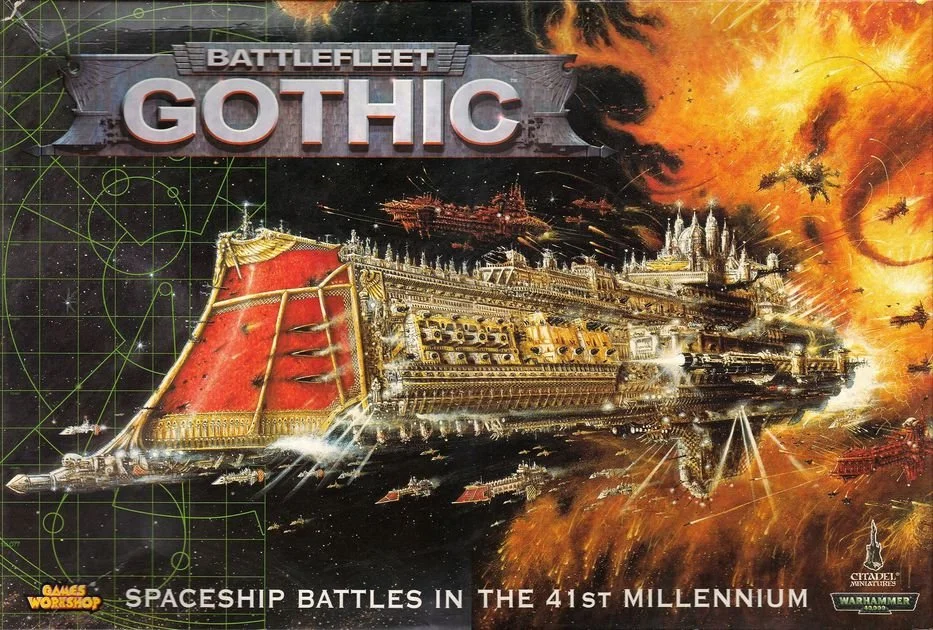
There's certain memories that drift unanchored through our minds, slipping beneath the waves and through the void. Games that trigger these recollections are ten to a dozen, always with a cargohold's worth of What If and Could Be. Battlefleet Gothic sits firmly in this lane as a game who's time has passed, but is not truly dead. Alongside Mordheim and Inquisitor, Battlefleet Gothic has taken a life of it's own in the internet communities. Living Rulebooks are updated and shared, STLs are designed and printed. Battlefleet Gothic lives on in multiples shapes and sizes.
However, to understand the possibilities, you must understand the history. BFG came at a very different era of Games Workshop, just before the turn of the Millennium. Experimentation was more common for good or for ill. Epic 40k was proving to be close to a disaster and the much loved Inquisitor was around the corner, both being fully realized attempts at exploring the different scales and tones within 40k. BFG zoomed that scale out further than even Epic was able to do, far beyond the personal combat of bolter and chainsword of the mainline 40K to a colder, grander size. This is the scale of planets being terrain and objectives rather than settings.
This was a measured take, deliberate and oddly beautiful in it's severity. Turns were commitments you may not see the full extent of for half the session, broadsides unloaded over time and movement carried the quiet inertia of terror. Reactions were slow, and often counter to the plan you had already committed to. Space combat was much less the zippy Star Wars battles than a mix of nautical dreadnoughts and undreamt of distances. It was a perfect tone for the vast grimness of the 41st millennium
As happens, BFG slowly slipped away. A quiet withdrawal as priorities shifted and focused on newer releases. The fact that it was a system unto itself with bespoke models and terrain meant it was a very expensive game to produce and unfortunately, by the mid 2000s, the sales were not enough to keep it afloat. These practicalities may have been one of the reasons it began to fade, but they were also the reason it was so loved. It built something truly unforgettable for fans of 40k, which of course were built on the bones of something else.
Space Fleet. the first take of the space ship battle game from GW was designed under the name of Battlefleet Gothic. The designs from Jes Goodwin that littered the book and design aesthetic build a foundation for what 40k would become over the next decade. Seriously, look at his concept art from 1998 and the last three years of Imperial releases for Kill Team.
As mentioned earlier, BFG fading away from being a supported system meant it wasn't on shelves, but the community persisted. Rules circulated through messages boards, Fleets were maintained and photographed. Ebay was trawled. The concept of BFG refused to dissipate, but evolved. The rules stayed the same, but the fanbase changed, tapping into that fundamental, unexplainable persistence that can only be achieved through sheer enthusiasm. To live beyond the shelf life of a product is rarely an accident, but happens when the mental images conjured up are too strong to dismiss or the joy of the muscle memory when recounting a game comes into play.
Which of course brings us inevitably to the big question.
Can it be brought back?
Should it be brought back?
In GW's current era, this feels far less improbable than it would have done een half a decade ago (which was 2020 by the way). Horus Heresy, Necromunda and Nu-Epic1 have demonstrated that there is a hunger for more focused, niche experiences. Not every release needs to dominate2, but simply justifying it's own existence via a dedicated audience is more than enough. The Old World has shown how far a single return to form can fly. In this sense, Battlefleet Gothic is a perfect example as it occupies a scale unto it's own, has a strong identity and would benefit enormously from modern sculpting and production techniques.
However, my counter. At this moment, 40k has multiple lines of different games all set in the same setting, though at different times. Adding another to that could well be the back breaking straw that current times do not need. As much as it's a delight to get carried away imagining the refined, contemporary version of BFG, the danger also lies in by doing so, by reshaping it too much, you loose the slow commitment and sense of consequence that lies at the heart of the game. The identity of BFG is bound up in the time of it's release alongside the gigantic space cathedrals filled to the brim with planet-killing artillery. It was always a less forgiving game than those it sat alongside, and whilst not an unappealing quality, modern needs may wish to transform that into something broader, which dances on the knife-edge of expectation.
Despite my naysaying, Battlefleet Gothic deserves to be remembered and celebrated. It started life burning brightly until it began to fade and slowly, it began to exert a lingering pull drawing new player towards it after death. It continues to effect 40k in a multitude of ways even now, 20-something years later, and that is no small achievement.
As always, I remain
Adam
1 -I know it's not called that but habits are hard to shake
2- (though shareholders disagree, which is why I would like to bring back the Wicker Man)i