Bloody Books - Chem Dogs by Callum Davis
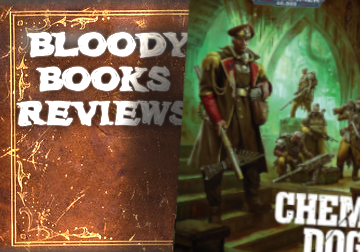
As we open the pages of Chem Dogs we find that, in the grand tradition of the Imperium, the war for the world of Kruxx is going extremely badly. A Ork Waaaaagh is loudly winning the the opening round by stealing an Imperial bastion and turning it into their new hobby project. The Astra Militarum response is to throw a grab bag of regiments at the problem and hope that enough lasguns pointed in roughly the same direction will eventually solve it¹. Into this mess strides Commissar Hasp (a man whose bedside manner could best be described as “enthusiastic vivisection.”) who had been given command of a kill team made up of Savlar Chem-Dogs, which is to say the sort of soldiers you deploy when you’ve already accepted the paperwork will list them as “lost under regrettable but statistically convenient circumstances.” The mission is simple in the way all terrible ideas are simple: sneak into an Ork-held fortress, retrieve some critically important Commissariat intelligence, and somehow not die in the process².
Naturally, this is a punishment detail. Hasp gets it because he annoyed someone higher up the food chain, and the Savlar get it because the Imperium hasn’t figured out how to execute them twice. Team cohesion is not high. Hasp views his squad as barely sentient contaminants in uniform, while the Savlar regard him as a walking argument for fragging your superior officer and claiming it was enemy fire³. If you’re coming in from the preceding short story, you’d be forgiven for wondering how this is supposed to sustain an entire novel. Hasp, at first glance, has all the nuance of a brick wrapped in barbed wire. This is a man who solves morale issues by removing teeth, fingernails, or anything else that might be contributing to an excess of personality. It’s the sort of characterization that works great in small doses but raises questions when promoted to “main character, please carry 300 pages.”
Credit where it’s due: the book does the work. Hasp doesn’t become nicer, because that would be illegal under several sections of Imperial doctrine, but he does become more comprehensible. His brutality isn’t random; it’s the logical endpoint of a worldview where duty is absolute and weakness is a moral failing—especially his own. He is, in essence, just as cruel to himself as he is to everyone else, which doesn’t make him likable so much as it makes him coherent⁴. The Savlar, meanwhile, are exactly what you want from a regiment of chemically enthusiastic reprobates. They bicker, they complain, they take the absolute minimum pride in their work, and they display the kind of gallows humor that comes from knowing you are both expendable and entirely aware of it. The early sections, where they’re trudging across a wasteland and filling the time with insults and low-grade mutiny, are some of the strongest in the book. It feels lived-in in a way that a lot of more “heroic” Guard stories never quite manage⁵.
What’s particularly refreshing is that the book refuses to give you the easy version of this story. There’s no sudden emotional breakthrough where everyone learns the value of teamwork and friendship before charging heroically into the sunset. Instead, what you get is a slow, reluctant, deeply incomplete shift. Hasp doesn’t stop despising the Savlar; he just occasionally recognizes that they are, inconveniently, competent. The Savlar don’t start respecting Hasp; they just adjust to the fact that he is slightly less likely to get them all killed than expected. It’s not a reconciliation so much as a marginal improvement in a bad situation⁶.
The writing itself keeps things moving. Internal monologue is present but never indulgent, threaded through action rather than halting it. This is a book that understands pacing, which is good, because the alternative would be several hundred pages of people marching and complaining, which, while accurate, might test the reader’s patience. When it comes time for the big confrontation, the story makes another smart choice by not trying to outdo the entire setting. The threat is appropriate to the scale of the narrative, and more importantly, it behaves in a way that makes sense within that scale. It has a territory, a pattern, and a presence that turns the final act into something tactical rather than purely explosive. It’s less about overwhelming force and more about surviving something that is very good at what it does⁷. That said, the back half doesn’t quite maintain the same character-focused energy as the front. The banter and small moments that did so much heavy lifting early on become less prominent as the plot tightens. It’s not that the characters stop working; it’s just that they get less room to breathe. If you came for the interpersonal chaos, you may notice it tapering off a bit as things get more serious⁸. Still, the book sticks the landing. It doesn’t overreach, it doesn’t collapse under its own ambitions, and it avoids several extremely obvious narrative traps along the way. For a debut novel, that level of restraint is almost suspiciously competent⁹.
All told, this is a strong showing. It takes a concept that could have easily devolved into caricature and instead delivers something sharper, meaner, and far interesting. Also, importantly, it leaves enough survivors that you could reasonably come back to this particular band of disasters, which feels like exactly the kind of poor decision the Imperium would make¹⁰.
¹ The traditional three-step Imperial strategy: deploy, overcommit, write memorials.
² “Simple” here meaning “will absolutely result in screaming.”
³ A time-honored Guard pastime.
⁴ Which, in the Imperium, is basically the same thing as being well-adjusted.
⁵ Misery loves company, and apparently so do readers.
⁶ Personal growth, Warhammer 40,000 edition.
⁷ Always nice when the enemy isn’t just a health bar with legs.
⁸ Plot: the natural enemy of hanging out and vibing.
⁹ Suspicious in the sense that one begins to expect future emotional damage.
¹⁰ The Imperium has never once learned from its mistakes and will not start now.