
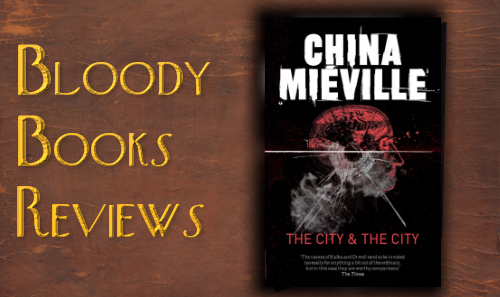
There are books you race through because you simply have to know what happens next. Then there are books you read because every page forces your brain to recalibrate. The City & The City is firmly in the second camp. China Miéville has never been interested in taking the easy route, and this might just be his most deceptively simple novel, as on the surface it is a police procedural. The kind that people take on summer holidays to read on the beach. But of course, if that were the case, this review would not exist.
A body is discovered. Inspector Tyador Borlú is assigned the case. Clues are followed, suspects questioned, conspiracies uncovered. Strip away the impossible architecture surrounding it and this is a wonderfully traditional detective novel. The genius lies in the fact that Miéville never strips that architecture away.
The central conceit is one of those ideas that is so absurd it somehow becomes believable. Two cities occupy exactly the same physical space. Their streets intersect, their buildings stand side by side and, in places, even overlap. Yet the citizens of Besźel and Ul Qoma spend their entire lives trained not merely to ignore one another but to actively unsee each other. Looking at the wrong person, noticing the wrong building, even acknowledging the wrong traffic can constitute the ultimate crime of Breach. The remarkable thing isn't simply that Miéville invented this bizarre social contract. It's that after fifty pages you stop questioning it. Like the inhabitants themselves, you begin unconsciously filtering your own perceptions. It is one of the cleverest pieces of immersive worldbuilding in modern speculative fiction, not because it relies on magic or technology, but because it is built almost entirely on learned behaviour. By the end of the novel, you realise there is very little forcing the citizens to obey beyond culture, fear and generations of conditioning. That makes it all the more unsettling.
That does, however, make the opening chapters something of a challenge. Miéville refuses to pause for a comforting lecture explaining how everything works. New words, unfamiliar customs and political tensions are thrown at the reader with complete confidence that you'll eventually catch up. Some readers will bounce off this approach entirely. Others will delight in piecing together the rules from context. I'm firmly in the latter camp, but I can understand why someone expecting a conventional fantasy or crime novel might find themselves repeatedly flipping back a few pages wondering whether they'd accidentally skipped a chapter. It's worth saying that it took me three attempts to truly get the novel. Once it clicked, however, I couldn't imagine it working any other way.
What surprised me most was just how restrained the novel is. Anyone coming from Perdido Street Station or The Scar might expect grotesque monsters, impossible biology and baroque excess. Instead, The City & The City is almost austere. The speculative element is astonishingly focused. Miéville takes one impossible idea and explores every consequence of it with forensic precision. Politics, nationalism, prejudice, bureaucracy, identity and even simple body language are all filtered through this singular concept. His prose is leaner than in the Bas-Lag novels, but no less deliberate, every unfamiliar term reinforcing the feeling that you're a visitor trying to navigate an alien culture. It feels less like reading fantasy and more like participating in an elaborate philosophical experiment.
Equally fascinating is the history Miéville invents for Besźel and Ul Qoma. Like the best fictional histories, it never feels as though it exists simply to impress the reader. Fragments of disputed archaeology, competing national myths, forgotten occupations, shifting borders and political revolutions bleed naturally into everyday conversation. No one agrees precisely when the cities diverged, whether one gave birth to the other or whether they have always existed as uneasy neighbours. Miéville even populates the novel with competing academic theories surrounding the mysterious Orciny, a possibly mythical third city whose existence is debated with the sort of passionate certainty only academics can truly muster. It reads less like fantasy lore and more like genuine historiography, where every discovery creates three new disagreements. Real nations rarely agree on their own histories, and Miéville understands that collective memory is every bit as political as geography. The result is a setting that feels lived in rather than designed, with centuries of arguments buried beneath every pavement slab.
The murder mystery itself is excellent, even if it occasionally feels overshadowed by the setting. Borlú is exactly the sort of detective noir fiction has trained us to expect: weary, methodical and quietly dogged rather than spectacularly brilliant. He doesn't solve the mystery because he's Sherlock Holmes with better tailoring. He solves it because he keeps asking questions long after everyone else would rather he stopped. That grounded protagonist provides an ideal anchor while the world around him becomes increasingly surreal.
The supporting cast deserves credit too, even if they're never quite allowed to steal the limelight. Constable Lizbyet Corwi provides an excellent foil during the investigation's early stages, while Senior Detective Qussim Dhatt emerges as Borlú's Ul Qoman counterpart once the case crosses the border. Alongside the academics, politicians and foreign investigators, each embodies a different way of seeing the cities. None are larger-than-life personalities, and that's entirely the point. They feel like ordinary people trying to navigate an extraordinary social contract. Borlú's growing professional respect for Dhatt quietly chips away at the invisible barriers between the two cities, suggesting that beneath decades of conditioning there remains an instinctive curiosity—and even camaraderie—between people taught to pretend the other simply doesn't exist.
Hovering over everything is Breach itself. Miéville turns what could have been a simple law enforcement agency into something approaching folklore. It exists somewhere between secret police, divine judgement and an unwritten law of physics. Everyone knows Breach is real. Nobody is entirely certain where its authority begins or ends. That uncertainty hangs over every page. The greatest threat is not always the murderer; sometimes it's stepping onto the wrong pavement and being seen by the wrong eyes.
However, the ending doesn't quite reach the dizzying heights promised by the premise. The investigation remains compelling throughout, but once enough of the world's mechanics become clear, some of the mystery inevitably evaporates. That's almost unavoidable. There is simply no ending capable of matching the exhilaration of finally understanding what Miéville has been quietly teaching you to see. The destination is satisfying, but the journey remains the true masterpiece.
Perhaps what lingers longest isn't the crime at all, but the uncomfortable realisation that Miéville isn't writing about imaginary cities. We all learn what to see and, more importantly, what not to see. Borders, class divisions, invisible communities and unwritten social rules exist all around us. The City & The City simply exaggerates them until they become impossible to ignore. Ironically, by asking us to spend three hundred pages practising "unseeing", Miéville forces us to notice far more about our own world than we might otherwise have done.
This isn't the easiest novel you'll read, nor is it the most emotionally affecting. It won't overwhelm you with heroic battles or dramatic speeches, and if you're looking for a straightforward fantasy adventure you'll probably come away disappointed. But if you enjoy speculative fiction that trusts its readers, rewards careful attention and demonstrates that a single brilliant idea can carry an entire novel, then The City & The City deserves every bit of its reputation. Some books entertain. Some books challenge. A rare few quietly change the way you think about the world around you. This is one of them. It's weird fiction wearing the clothes of a detective novel, quietly asking you to look twice at the street you've been walking down all along. Just don't be surprised if, once you've finished it, you begin wondering what you've spent your whole life learning not to see.