The Art Of War - The Summoning
Let us step back into the late Nineties.
Black Library was in its absolute infancy, experimenting wildly to see what stuck to the grimdark wall. Before it became the monolith of thick paperback series and sweeping multi-novel heresies we know today, there was a glorious, ink-stained crucible of monthly sequential art. Before the comic officially launched its regular run, there was Issue 0 that held both The Bridge and this self-contained, three-page short strip titled "The Summoning."
Scripted by Andy Jones, drawn with kinetic hostility by Simon Davis, and lettered by David Pugh, The Summoning is three pages of pure, old-school Warhammer fantasy grit. It's a fascinating artifact because it perfectly encapsulates the early Warhammer Monthly as it’s utterly dripping with incredible, claustrophobic atmosphere, yet completely trapped by its own brief runtime and a somewhat goofy narrative loophole.
Strong points first. Simon Davis's artwork, because it is the definition of a double-edged sword. On one hand, you could practically scrape the charcoal off these panels with a hobby knife. The strip opens on a pair of glowing-eyed carrion crows overlooking a siege, immediately establishing the Oldhammer aesthetic we endlessly wax lyrical about. Davis doesn't sketch characters; he carves them out of the dark. The antagonist (a nameless, veins-bulging, claw-fingered Necromancer) looks less like a man and more like a collection of desperate, jagged lines and manic intent. On the other hand, Davis frequently crosses the line from "grimdark masterpiece" to "photocopied charcoal smudge." By page two, the panels are so choked with heavy black shadows and intense cross-hatching that it becomes difficult for the eyes to track the action. When the warrior tries to attack the Necromancer ("But I can make you hurt!"), the choreography is totally lost in a mess of overlapping anatomy and ink splatters. Davis relies so heavily on extreme close-ups of screaming mouths and bulging eyes that by panel five, the shock value wears off, leaving you wishing he would just pull the camera back to give the scene some actual spatial geography.
The narrative structure of The Summoning is a masterclass in tight short-story economy, even if it suffers from a bit of a tonal identity crisis. The Necromancer is running a standard villainous play: he has sacrificed a thousand souls to summon the literal "Ancient One" who built the fortress, all to secure a final victory tonight. But a ritual of this caliber requires a final anchor, a capstone to seal the breach.
“You are to be the final soul which seals the pact!”
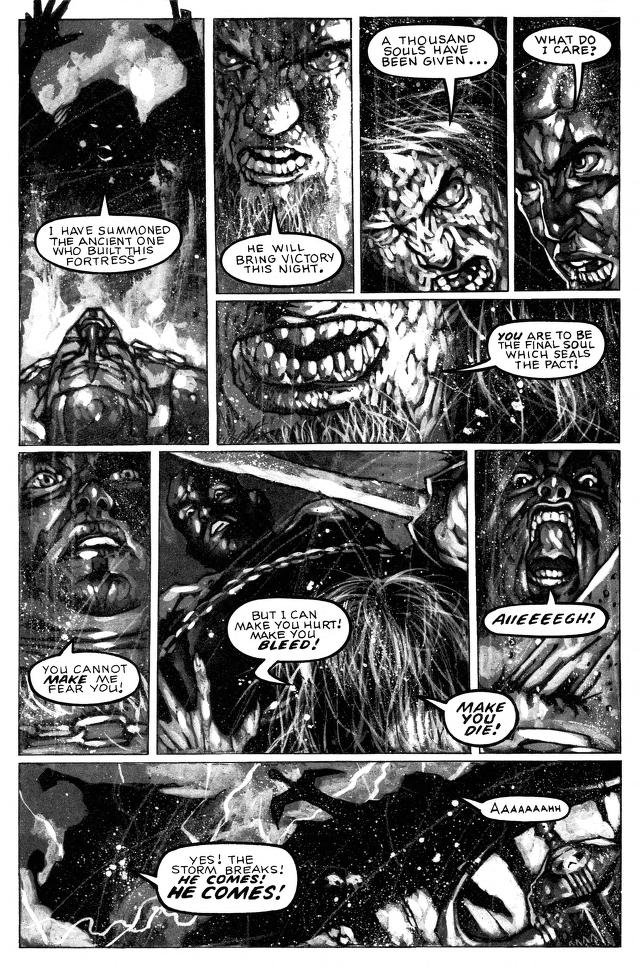
The script spends two and a half pages aggressively trying to convince you it is the most serious, edgy piece of dark fantasy ever written. And then it pivots entirely into a Tales from the Crypt punchline. With his absolute dying breath, the warrior turns his head, flashes a grotesque, bloody grin, and drops the ultimate cosmic middle finger.
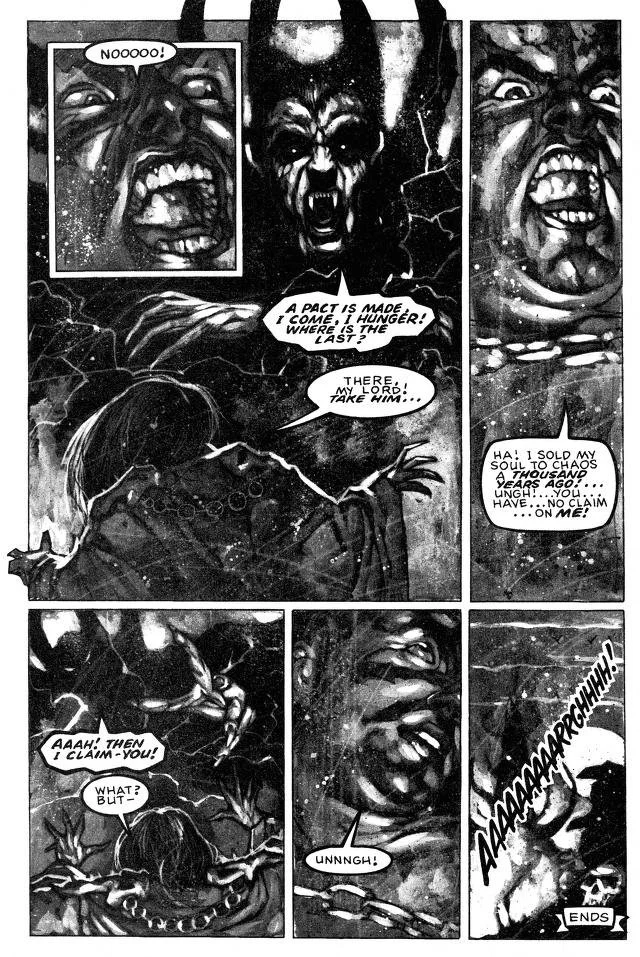
“Ha! I sold my soul to Chaos a thousand years ago!... Ungh!... You... have... no claim... on me!”
It is an incredible, bureaucratic twist. The warrior has used the ultimate terms-and-conditions loophole to ruin an evil ritual. Because his soul was already signed away to the Ruinous Powers a centaury prior, his spiritual contract is legally void. As a punchline, it’s highly entertaining. The final panels are a joy, as the nameless summoned entity realizes it has been short-changed on its cosmic invoice. Turning its massive, shadow-drenched claws on the mastermind, it declares: “AAAH! Then I claim—YOU!” The strip ends on the Necromancer’s pathetic, wide-eyed realization—“What? But—”—as he is dragged screaming into the abyss.
The Summoning is a classic example of early Warhammer Monthly short-form storytelling. It didn't have the space of Bloodquest or the ongoing character development of Kal Jericho, so it defaulted to a predictable "deal with the devil" trope that could have been published in any bargain-bin horror anthology. Yet, despite the muddy artwork and the silly logical leaps, it captures the true thesis of the Old World: everyone is terrible, the universe is uncaring, and if you’re going to hell, you might as well spite-drag the guy who put you on the altar down with you. It’s flawed, it’s a bit messy, but it remains a wonderfully cynical highlight from the dawn of Warhammer's comic age.