The Art Of War - The Bridge
Whilst WHAM! is on hiatus due to Real Life Issues (Don't worry, we will return to it), I thought it may be fun to dissect some of the one shot strips that Warhammer Monthly published.
We begin with issue 0, and the first strip published in that hallowed comic.
There is something wonderfully self-destructive about early Warhammer 40,000 fiction that modern interpretations occasionally forget. Contemporary 40K often presents itself with blockbuster seriousness: sweeping epics, galaxy-shattering stakes, and protagonists grimly staring into middle distance while orchestral music swells somewhere off-camera. Early 40K, by contrast, frequently operated on the logic of a half-remembered Motörhead album cover spray-painted onto the side of a transit van in 1989. It was ugly, loud, hysterically violent, and just intelligent enough to know how ridiculous it all was.
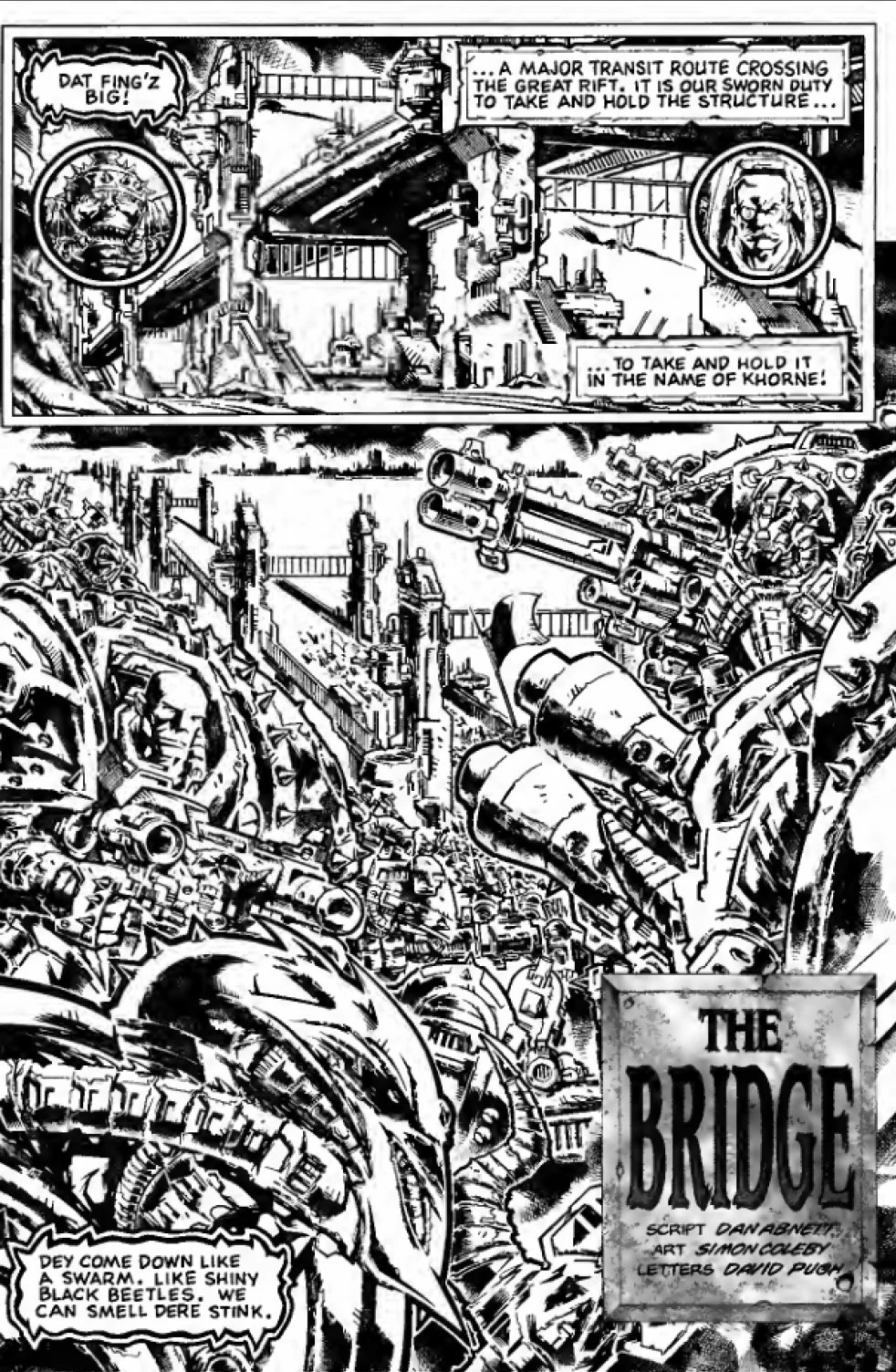
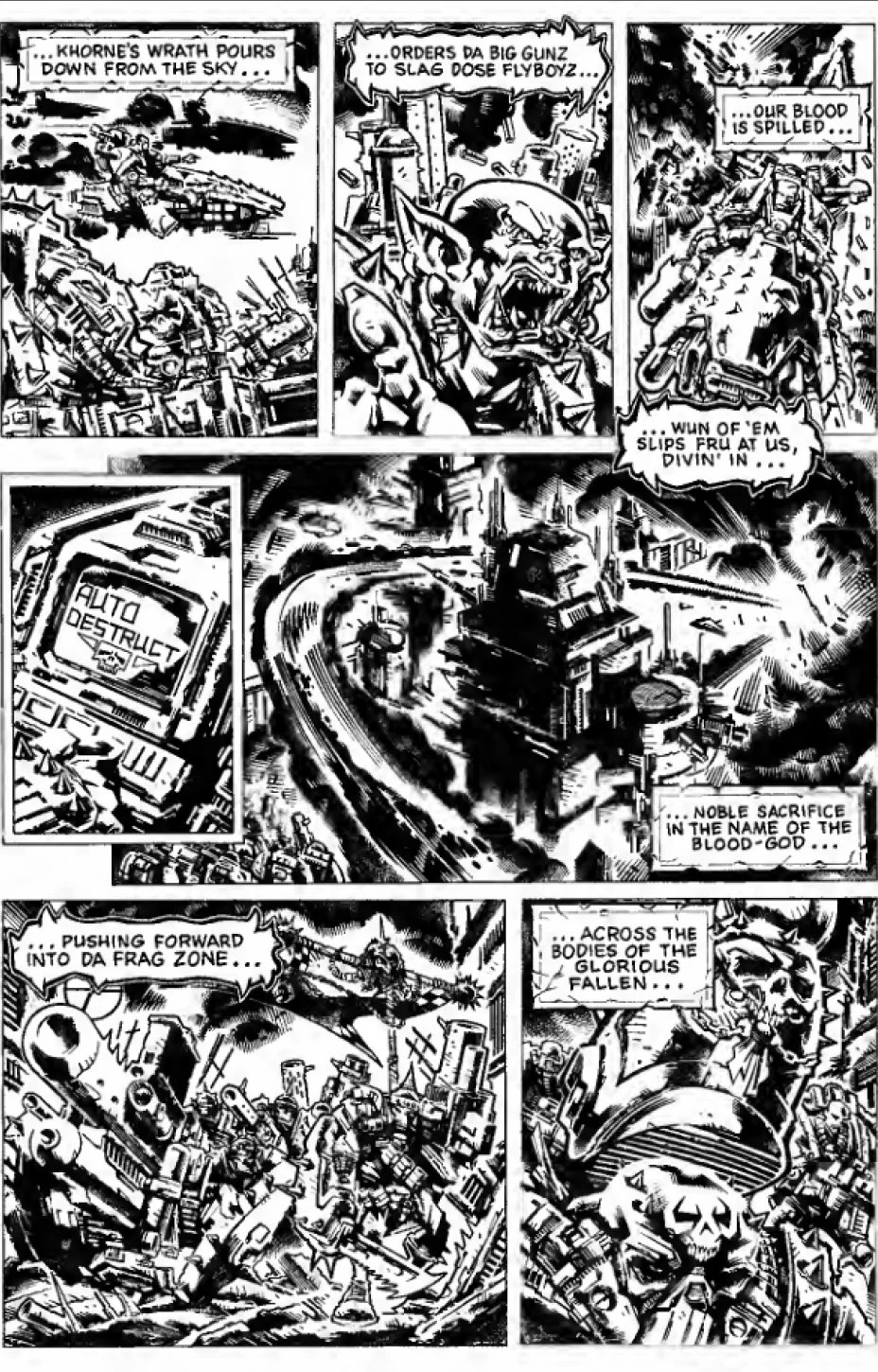
Nowhere is that spirit better preserved than in “The Bridge,” published in issue zero of Warhammer Monthly. Scripted by Dan Abnett, illustrated by Simon Coleby, and lettered by David Pugh, the strip is only a handful of pages long, yet somehow manages to distil the entire essence of classic 40K into one brutal little joke.
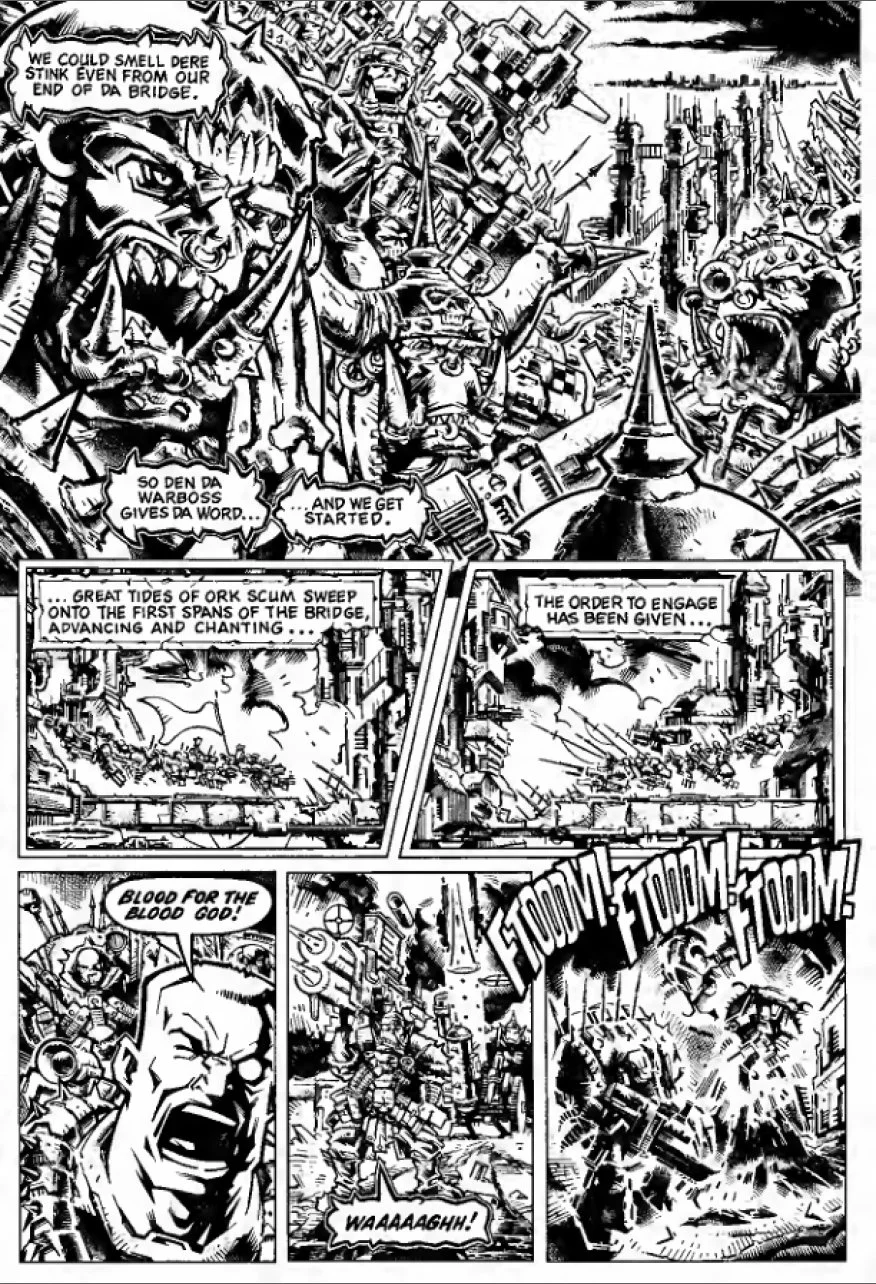
On the surface, it is straightforward enough. Chaos Space Marines and Orks are fighting over a gigantic bridge somewhere in the grim darkness of the far future. There are chainaxes. There are roaring greenskins. Somebody almost certainly loses an organ in the first three panels. Standard procedure.
The cleverness lies in the structure.
Abnett tells the story through alternating perspectives between a Chaos Champion and an Ork Nob, each narrating the battle in their own cultural voice. The Chaos Marine bellows ritualistic scripture about honour, fury, and sacred slaughter in stern caption boxes that feel carved from granite. The Ork, meanwhile, communicates entirely through joyous screaming and what can only loosely be described as grammar.
Initially, the contrast feels enormous. The Chaos Marine sees himself as a noble warrior-priest elevated by devotion to Khorne. The Ork simply wants a good scrap. But as the comic escalates, the distinction collapses completely. Both sides are addicted to violence. Both measure existence through domination. Neither actually cares about the strategic value of the bridge itself.
The Chaos Marine merely wraps his bloodlust in theological language to make it sound intellectual. Underneath all the brass trim and screaming devotionals, he is basically just an Ork with better vocabulary and significantly worse emotional regulation.
That is pure old-school 40K satire.
Early 40K loved exposing the hypocrisy of its factions. The Imperium claimed enlightenment while behaving like a medieval death cult. Chaos preached freedom while enslaving itself to obsession. Everyone insisted they were sophisticated while acting like absolute lunatics. “The Bridge” continues that tradition beautifully by revealing that the supposedly superior Chaos Marines and the Orks they despise are functionally indistinguishable once the axes start swinging.
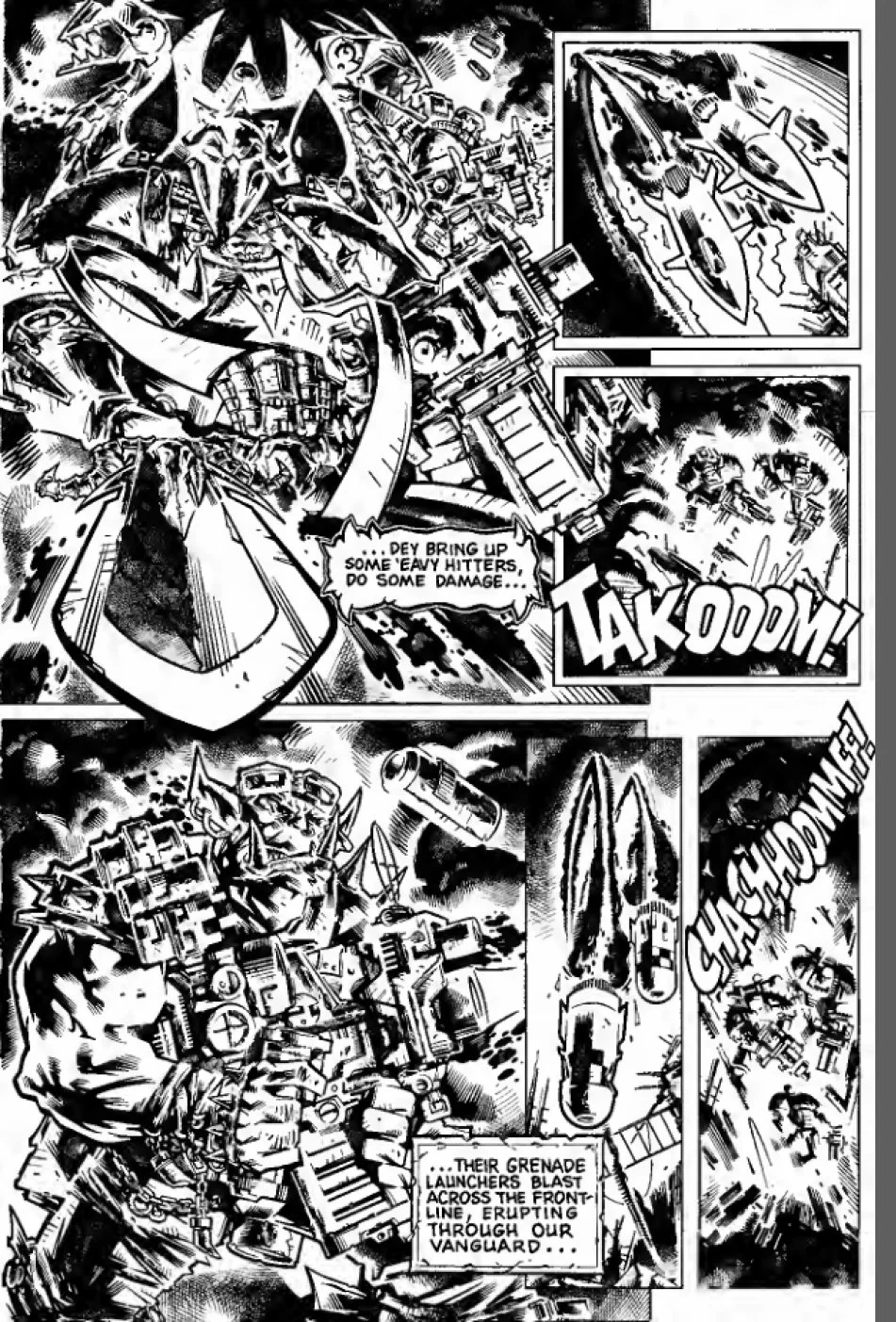
Visually, Simon Coleby absolutely hurls the reader into the meat grinder. Modern comics tend to favour clean cinematic layouts. “The Bridge” instead resembles somebody emptying an industrial skip full of rivets, smoke, skulls, shell casings, and chainsword teeth directly onto the page. Panels are dense, claustrophobic, and occasionally so overloaded with violence that readability itself becomes a casualty of war.
Honestly, that only adds to the charm. This was 1990s British comics. Nobody involved ever looked at a page and thought, “perhaps this needs fewer explosions.” If a panel remained comprehensible at first glance, the obvious solution was to add more smoke and at least three additional skulls.
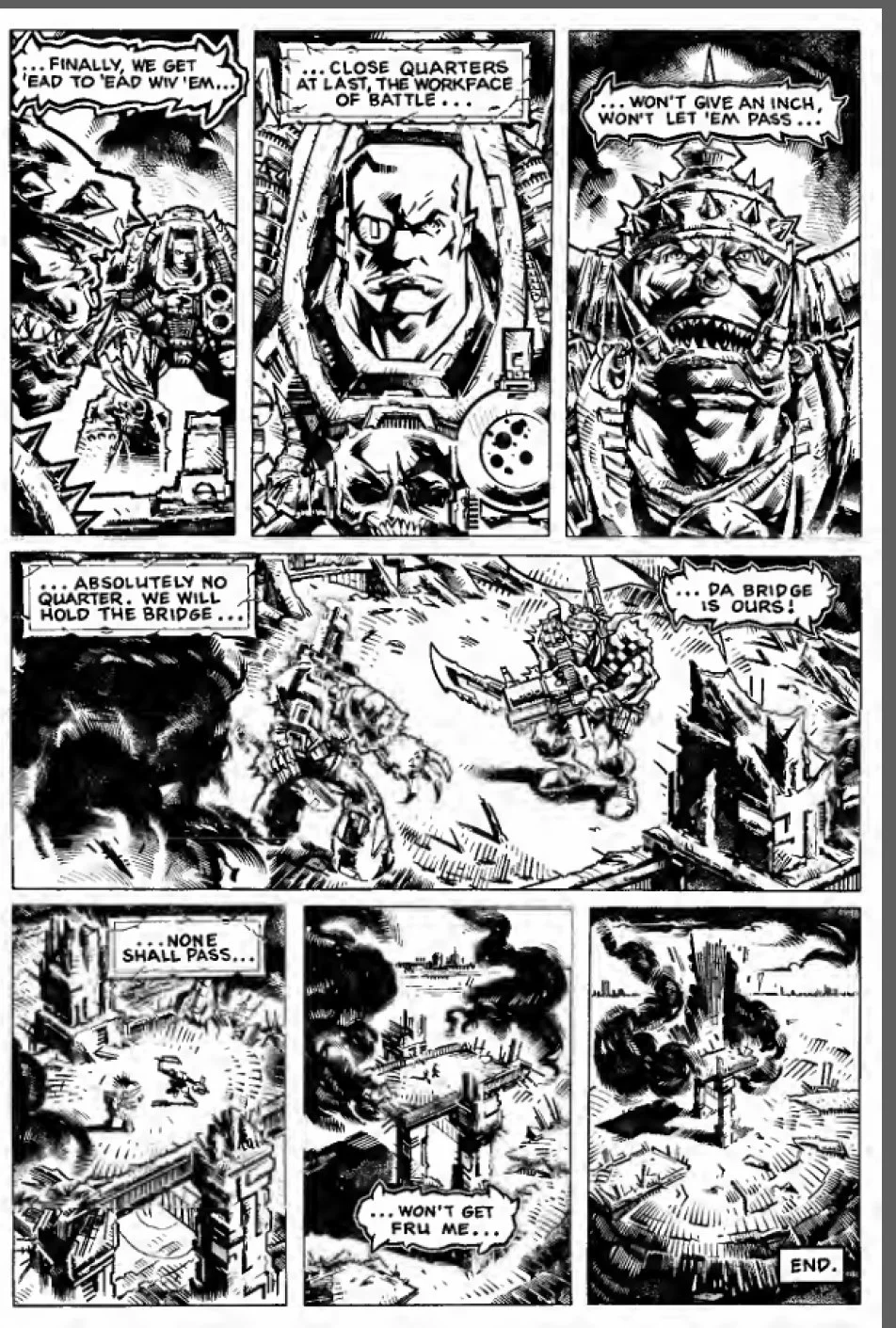
The battle itself unfolds almost exactly like a tabletop game. First comes the movement phase as both sides manoeuvre toward the bridge. Then the shooting phase erupts into total chaos with heavy weapons hammering across the span while vehicles explode theatrically in every direction. Eventually the distance collapses and, like every memorable game of 40K, the firefight degenerates into close combat because rational military tactics are for cowards and lesser settings.
And then comes the ending.
It is genuinely brilliant.
As the Ork Nob and Chaos Champion clash in single combat, both scream triumphantly about claiming the bridge. They rage. They posture. They declare absolute victory. Then the perspective pulls back for the final panel.
The bridge is gone.
The sheer fury of the battle has destroyed the structure entirely, leaving both warriors stranded on opposite ends of a shattered ruin, still yelling threats across a gulf neither can cross. The strategic objective they were sent to capture has been obliterated by the act of fighting over it.
That final image perfectly encapsulates classic 40K. Nobody wins because the process of winning destroys the thing worth winning in the first place. Civilisations collapse under the weight of endless war while their inhabitants remain far too angry to notice.
And the best part is that neither side particularly cares. The World Eater is still screaming praises to Khorne. The Ork is still looking for another fight. Both are trapped on isolated pillars above a bottomless void, furiously shouting into smoke over a pathway that no longer leads anywhere.
Which, when you think about it, is also a fairly accurate description of a second edition game played on a kitchen table covered in polystyrene ruins and suspiciously familiar washing-up liquid bottles.