The Art Of War - The Summoning
Let us travel back to the late Nineties. A time when jeans were wide, dial-up internet sounded like a dial-facing toaster being murdered, and Black Library was in its infancy. Before it became the monolith of thick paperback series and sweeping, multi-novel heresies we know today, it was a crucible of monthly sequential art. You can find out more by listening to WHAM! every fortnight on this very site.
The grimdark is a creation with a long shadow throughout the decades of our hobby, and within that particular genre, the tale of early Black Library is easily one of the most romanticized. In fact, it's only been a short time since the monolithic, sweeping multi-novel heresies and thick paperback series came to completely dominate the shelves. Through the last thirty years, few settings have been interpreted, adapted, and re-codified as many times as the Warhammer universes. Warhammer is synonymous with the medium of tabletop gaming itself, reborn in perpetual edition reanimation. However, looking back at the earliest attempts at sequential art are a fascinating window into how the evolutions take place.
Before Warhammer Monthly officially launched its regular run, there was the legendary Issue #0. It’s remembered mostly for The Bridge, but buried alongside it was a self-contained, three-page short strip titled "The Summoning." Scripted by Andy Jones and lettered by David Pugh, it took on the task of capturing the Old World and dug deep into the setting's legends in a manner few modern strips ever truly do. Gone are the later inventions of perfectly clean canon compliance, and the deeper, older concepts reemerge into play.
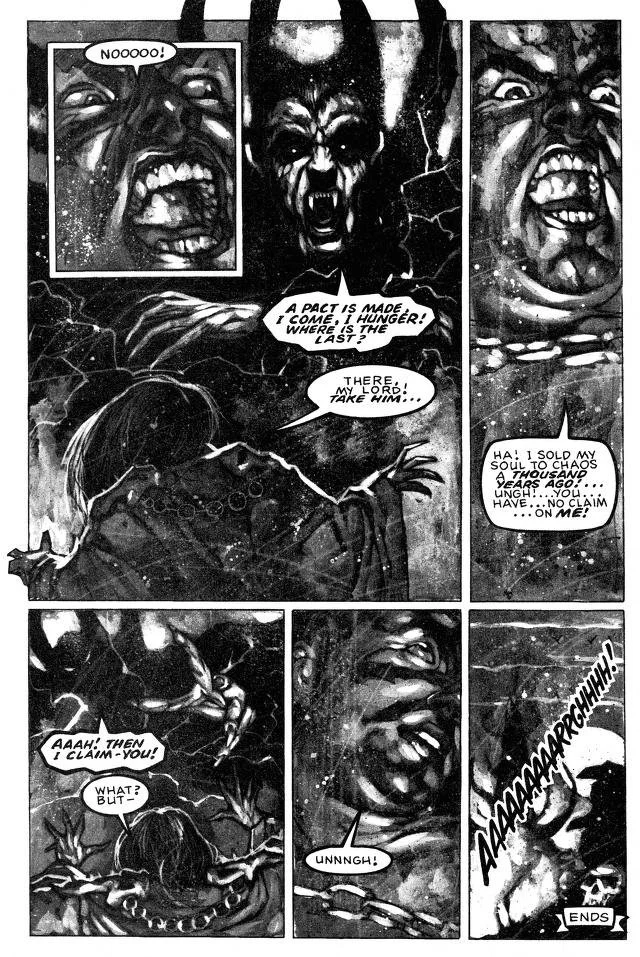
Draw with kinetic hostility by Simon Davis, The Summoning is three pages of pure, old-school grit. Let’s cast an eye on Davis’s artwork, because it is the definition of how Grimdark’s brainfeel works. You could practically scrape the charcoal off these panels with a hobby knife. It’s not the intricate, scratchy gothic madness of Ian Miller, and it’s not the high-contrast, shadow-drowned theatre of John Blanche, but there’s enough in the DNA to feel the connection. It hits the subconscious like a uncovered carving. It’s raw, tactile, and dredged up from a riverbed.
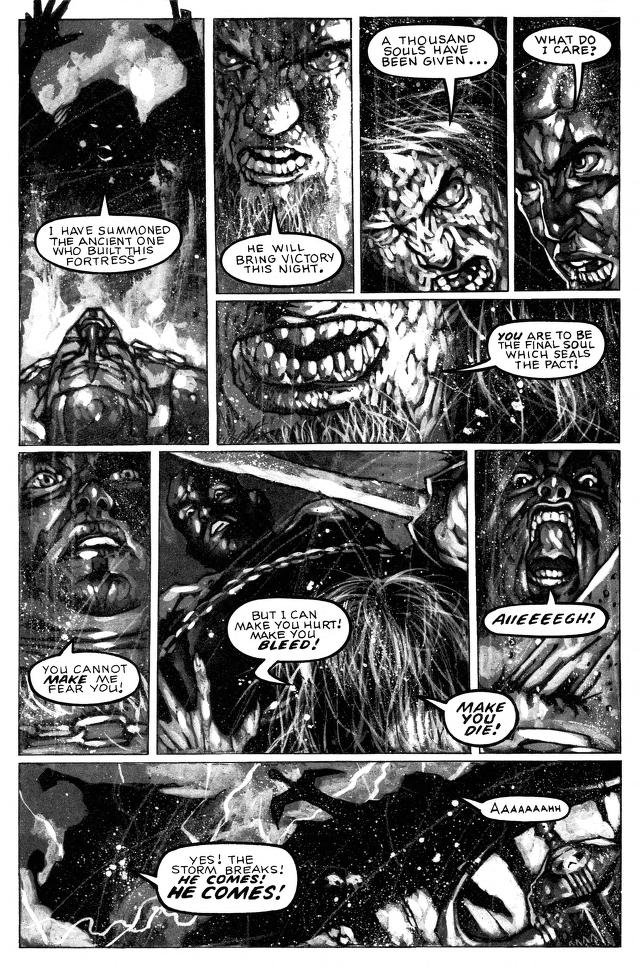
The strip opens on a pair of glowing-eyed carrion crows overlooking a siege, immediately establishing the Oldhammer aesthetic we here at The Fluff endlessly wax lyrical about. Davis doesn't sketch characters; he carves them out of the dark. The antagonist (a nameless, veiny, clawed Necromancer) looks less like a man and more like a collection of desperate, manic intents.
Yet, Davis frequently crosses the line from masterpiece to photocopied smudge. When the warrior tries to attack the Necromancer (“But I can make you hurt!”), the choreography is totally lost in a gorgeous but incoherent mess of overlapping anatomy and ink. Davis relies so heavily on extreme close-ups of screaming mouths and bulging eyes that by panel five, the shock value wears off. You’re left wishing he would just pull the camera back to give the scene some actual spatial geography.
The Summoning is a tale of pestilence and misfortune. A dank, dark experience. The narrative structure is a masterclass in tight short-story economy, even if it suffers from a bit of a tonal identity crisis. The Necromancer is running a standard villainous play: he has sacrificed a thousand souls to summon the literal "Ancient One" who built the fortress, all to secure a final victory tonight. But a ritual of this caliber requires a final anchor—a capstone to seal the breach.
The script spends two and a half pages aggressively trying to convince you it’s a serious, edgy piece of dark fantasy until, without warning, it pivots entirely into a Tales from the Crypt punchline. I cannot help but love it for that. Humour should be found within such darkness for both balance and brevity. The fact this three-page strip rockets from one to the other is to be applauded. Absolute grimness without a wink eventually becomes monotonous, by injecting that dark punchline, the strip doesn't undermine the horror, it gives it flavor. It’s the laugh of a man who knows he’s utterly doomed, but realizes he has just enough breath left to ruin someone else's day.
With his absolute dying breath, the warrior turns his head, flashes a grotesque, bloody grin, and drops the ultimate cosmic v-sign.
It is an incredibly bureaucratic twist. The warrior has used the ultimate terms-and-conditions loophole to ruin an evil ritual. Because his spiritual equity was already signed away to the Ruinous Powers a millennium prior, his current contract is legally void. It turns out that while the universe is an uncaring, horrific meat-grinder, it is also bound by an absurd, immutable logic. The Chaos Gods might be chaotic, but apparently, they respect a prior contract.
The final panels are joyous, however. The nameless, summoned entity, upon realizing it has been short-changed on its cosmic invoice, turns its massive, shadow-drenched claws on the mastermind. It bellows at the Necromancer, who displays a pathetic, wide-eyed realization before being dragged screaming into the abyss by the nameless form. The cosmic collection agency is immediate.
The Summoning is a classic example of early Warhammer Monthly short-form storytelling. It didn't have the room to breathe of Bloodquest or the ongoing character development of Kal Jericho, so it defaulted to a predictable "deal with the devil" trope that could have been published in any bargain-bin horror anthology. Yet, despite the muddy artwork and the silly logical leaps, it captures the true thesis of the Old World. Everyone is terrible, the universe is uncaring, and if you’re going to hell anyway, you might as well spite-drag the guy who put you on the altar down with you.
The Jones script and the Davis art are the bones, as well they should be, with a hint of a larger, darker supernatural world behind the ink. It’s a reading experience of allusions and half-lit horrors. Warhammer fiction may be entrenched in the history of paperbacks, but this three-page artifact is pure comic book soul. Flawed, messy, and a bit silly.
Which is exactly why it remains a wonderful highlight from the dawn of Black Library's golden age.