SUNDAY MUSINGS - Skeleton Warriors!
There are certain opinions you arrive at in the hobby that are best kept quietly to yourself. You can admit, perhaps after several pints and only to people you trust, that you preferred second edition. You can cautiously suggest that the original plastic Goblins were actually rather charming. You can even, if you have completely abandoned any concern for your own safety, say that you think that Nagash was a better sculpt than people give it credit for. But there are some things you simply do not say in polite Oldhammer society. You do not question the beaky Space Marine. You do not suggest that RTB01 was anything less than a miraculous intervention from the gods of polystyrene. You certainly do not look at the first plastic Space Marines of Warhammer 40,000 and say, with a straight face, “Actually, I think the skeletons were better.”
So here I am, doing just that.
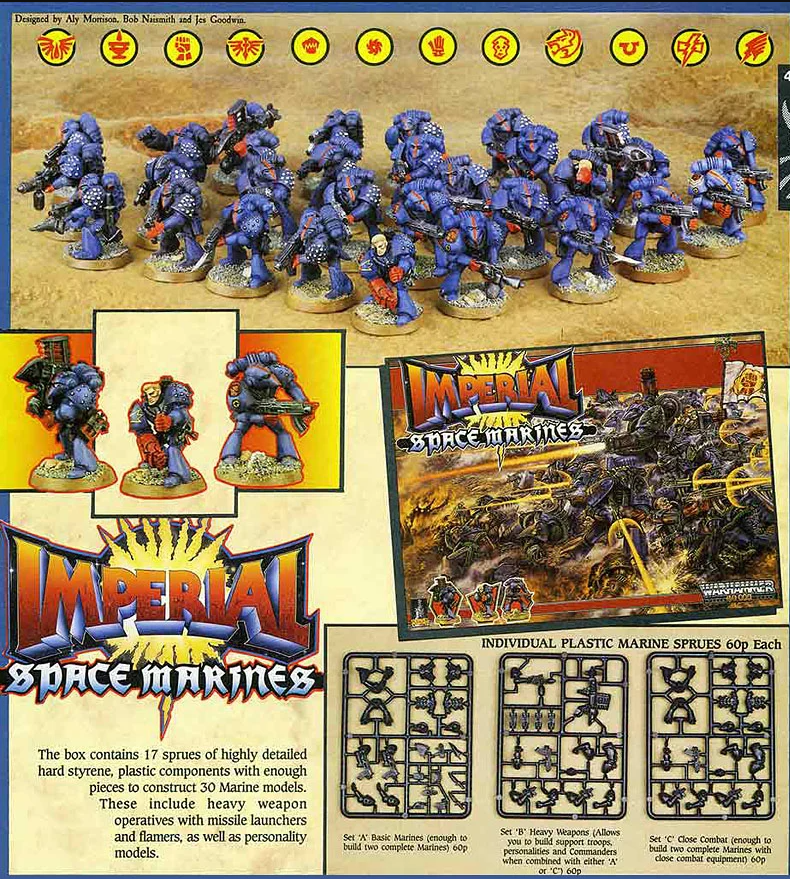
The outrageous proposition of this particular Sunday Musings is that the humble Citadel Miniatures Skeleton Horde, and particularly the Skeleton Army that followed it, represents a more successful piece of early plastic miniature design than RTB01, despite RTB01 being vastly more historically important. This isn't an argument that the original plastic Space Marines were bad. Quite the opposite. RTB01 is one of the most important miniature kits Games Workshop ever produced. Released in October 1987 alongside Warhammer 40,000: Rogue Trader, it contained seventeen plastic sprues capable of producing thirty Imperial Space Marines for £9.95, designed by Jes Goodwin, Aly Morrison and Bob Naismith. It helped establish the visual language of the Space Marine that would dominate Games Workshop for decades. But if we temporarily strip away the enormous historical shadow cast by the Space Marine and ask a slightly different question, which kit actually demonstrated what plastic was good for, then the skeletons begin to look considerably cleverer.
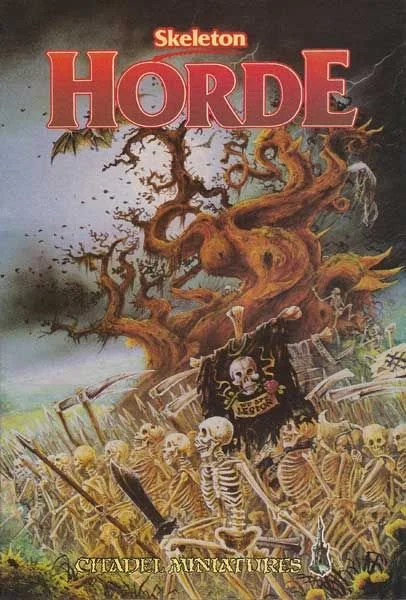
The important thing is that the skeletons came first. The Skeleton Horde was released in 1986, before Rogue Trader and before RTB01, and it was part of a series of increasingly ambitious experiments in plastic by Citadel. Psychostyrene Dwarfs and Drastik Plastik Orcs had already demonstrated that plastic could produce multi-part fantasy miniatures, but these were still very much experiments in a new material. The Skeleton Horde was the next significant step: six sprues making twenty-four skeletons, with separate heads and arms, multiple weapon options and four basic body sections.
What makes the contemporary reaction particularly fascinating is that Games Workshop wasn't simply saying, “These are cheaper than metal.” In Citadel Journal No.4, published in spring 1987, the company effectively described the Skeleton Horde as a breakthrough. Earlier plastics had not been as good as Citadel wanted, but the new skeletons were described as having limbs and spines thin enough to be realistic, something the company argued was difficult to achieve in metal because such components would snap. The detail was claimed to be better than Citadel's previous plastics and “as fine as metal”. The models also had separate heads and arms, allowing considerable variation from a relatively small number of body sections.
That is an enormously important distinction because it changes the usual story about the arrival of plastic. Plastic wasn't simply a cheap replacement for lead. It could actually solve problems that metal couldn't. The skeleton was almost the perfect creature with which to prove the point. A metal skeleton needs a certain amount of material in its limbs and ribs simply to survive being cast, transported, handled and played with. Plastic could produce something far thinner and lighter. The manufacturing limitation therefore became a design advantage. The skeletons could be spindly because they were supposed to be spindly, and what might have looked crude on a human miniature suddenly looked entirely appropriate on something that had been dead for several hundred years and was now being commanded by a necromancer with questionable staffing practices*.
This is where the skeletons start cheating, because a skeleton is perhaps the most forgiving possible creature to manufacture while a Space Marine has expectations. A Space Marine is supposed to have armour plates that overlap convincingly, limbs that connect properly, weapons that fit naturally into his hands and a silhouette that communicates a genetically engineered super-soldier wearing several hundred kilos of futuristic armour. Every component has to make sense against the anatomy underneath it. If the torso is too narrow, the legs too long, the arms slightly misplaced or the weapon held at an awkward angle, you notice immediately because the human form gives you something to compare it with.
A skeleton, meanwhile, has ribs, and if the rib cage is slightly too shallow it is still a rib cage. If the limbs are slightly oddly proportioned, it is still a skeleton. If the skull is too large, you have merely produced a skeleton with an unusually large skull, which is not exactly a deal-breaker in a hobby where we have spent forty years arguing about whether Chaos Spawn have enough tentacles. The limitations of early plastic therefore became part of the aesthetic. The Skeleton Horde didn't have to conceal the limitations of the material but instead it could embrace them.
More importantly, it was becoming a kit, rather than simply a miniature made out of plastic. The contemporary description specifically points to separate heads and arms, different weapons and interchangeable components, and that distinction is enormously important when viewed from the perspective of 1986. Today we take modular infantry kits completely for granted, but Citadel was still discovering how useful the principle could be. The body supplied the basic identity while the arms, heads, weapons and shields allowed the modeller to create variation.
RTB01 took that idea much further and did it brilliantly. Seventeen sprues producing thirty Space Marines for £9.95 was an extraordinary proposition in 1987, and the weapon selection was wonderfully Rogue Trader: bolters, bolt pistols, flamers, power fists, combat blades, bayonets, chainsaw bayonets and other pieces of equipment that look as though the design team had been told to put every vaguely military idea they had onto one sprue. The result is one of the most characterful plastic kits Games Workshop has ever produced.
But it was also fighting the physical reality of the human form. The Space Marine could not simply have his arm stuck on at whatever angle happened to fit. His weapon needed to connect to his hand. His backpack needed to sit behind him. His armour had to remain recognisable. His legs had to look like legs. His pose therefore became constrained by the engineering of the component. The skeletons didn't have that problem. You could swap a head, move an arm, change a weapon and create a figure that looked different enough without having to redesign the entire body.
That, I think, is the real achievement of the Skeleton Horde. It wasn't simply making plastic miniatures; it was beginning to demonstrate the idea ofplastic as a miniature system. One body could become several figures. One set of components could create variation. The modeller wasn't simply assembling a predetermined sculpture but participating in its final form. It is the same principle that would eventually become fundamental to Games Workshop's entire plastic business.
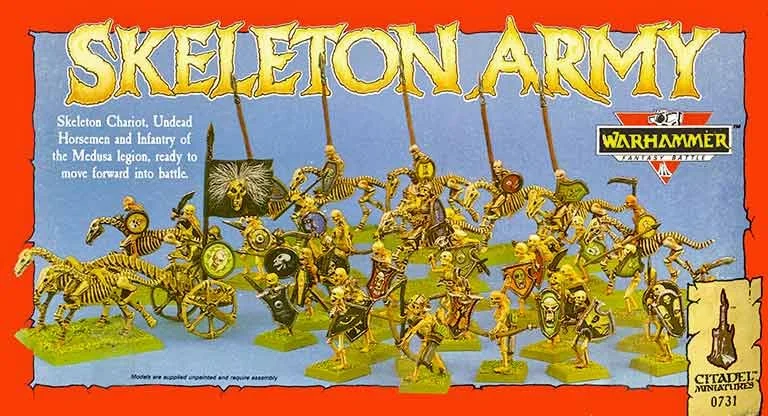
And then Games Workshop discovered what happens when you apply that principle to something people actually want in large numbers. The customer doesn't need one skeleton**. This is where the 1989 Skeleton Army becomes particularly interesting. The box took the existing Skeleton Horde infantry and expanded the concept into something approaching a complete army. Thirty plastic skeletons, eight skeletal horsemen and a chariot, for around £10. That is an almost absurd amount of miniature for the money, particularly when compared with the increasingly expensive individual metal figures that still dominated the hobby.
The difference isn't simply quantity. It demonstrates what Games Workshop was learning about the commercial possibilities of plastic. Metal miniatures were excellent for individual characters, specialists and small units because every figure could be individually sculpted and cast. Plastic made much more sense when you needed large numbers of something. The economics of expensive mould tooling only worked when you could produce and sell the resulting components in quantity, which is why mass infantry was always going to be one of plastic's great strengths.
The skeleton was therefore almost the perfect plastic miniature. Nobody buys an army of skeletons because they want thirty identical individuals. They want a horde. The repetition is the point. Thirty dead warriors shambling across a battlefield is more evocative than one beautifully sculpted skeleton standing in a display cabinet, and the ability to manufacture them cheaply meant Games Workshop could sell the fantasy of an army rather than merely a collection of miniatures. The Skeleton Army box therefore represents something that RTB01 only hints at. It isn't simply a box of miniatures but rather an argument for why plastic exists.
RTB01 is already pointing towards the future. The Space Marines are recognisable ancestors of the figures we know today. The beaky helmet, armour, backpack and weapons are all there though they will evolve dramatically. Over the following years the design would become increasingly coherent and standardised, until the Space Marine became not merely a miniature but the defining visual symbol of Games Workshop itself***
That was one of the great pleasures of Oldhammer. The distinction between the “correct” miniature and the “incorrect” miniature was much less rigid than it would eventually become. A spare head, a different weapon, a metal arm, an accessory from another kit – all of it was potential raw material. The Skeleton Horde positively encouraged that mentality because the kit itself was already asking you to construct the figure from interchangeable pieces. You could even put a Space Marine bolter in the hands of a skeleton, which is precisely the sort of thing that makes perfect sense in the Warhammer universe before anybody decided that the universe needed to make quite so much sense.
And that is another reason the Skeleton Horde has aged so well. The models aren't technically impressive by modern standards. Their details are soft. Their proportions are odd. Their poses are limited. Their moulding is obviously the product of the 1980s. But those limitations have become part of their character, and because the subject itself is so forgiving, the models remain instantly recognisable. They still look like Warhammer.
The original Skeleton Horde bodies remained useful for years, becoming the foundation of later Undead plastic infantry and surviving into the era when Games Workshop's fantasy ranges were becoming considerably more sophisticated. The fact that an early plastic design could remain commercially useful while the company around it changed so dramatically is evidence that the fundamental concept was right. Games Workshop could have replaced them much sooner, but it didn't need to.
That is something worth remembering when we talk about old plastics. Longevity is often a better indication of successful design than technical sophistication. A miniature doesn't have to be the most detailed thing ever produced. It has to work. It needs to assemble, look convincing, survive handling, accept paint and, ideally, still look good when you put twenty of them next to each other. The Skeleton Horde did all of those things.
RTB01 did too, of course. It simply had a much harder job. The original Space Marines are awkward. Their proportions are strange, their armour is thin by later standards and their poses can be stiff. Their weapons and equipment sometimes look hilariously oversized or bizarrely placed. Yet those very peculiarities are part of their appeal. They are the physical remains of the moment when Games Workshop had not yet decided exactly what a Space Marine was.
The history of Games Workshop's plastics is often told as though RTB01 was the great starting gun. For Warhammer 40,000, it effectively was. But the wider story is considerably more interesting. Psychostyrene Dwarfs and Drastik Plastik Orcs had already been exploring multi-part plastic figures. Skeleton Horde demonstrated that the material could produce delicate, mass-produced miniatures. RTB01 demonstrated that the same principles could be applied to the company's new science-fiction flagship; and Skeleton Army demonstrated just how far the idea could be pushed when the objective was no longer simply to make plastic figures, but to sell an army in a box.
That distinction is why I think the Skeleton Horde deserves more attention than it usually gets. It wasn't simply one of those charming old kits that collectors remember because they had one under the Christmas tree in 1987. It was part of Games Workshop learning how to make the product that would eventually define the company: affordable, modular, mass-produced miniatures that a hobbyist could assemble, convert, paint and deploy in large numbers.
And there is something wonderfully appropriate about the fact that the lesson was delivered by a box of dead men. The Space Marines were going to conquer the galaxy. They were going to become the most recognisable miniatures in the world of tabletop gaming, appear on computer games, novels, television screens and endless shelves of increasingly enormous plastic kits. They were going to acquire countless armour marks, chapters, characters, vehicles and approximately seven billion slightly different shoulder pads.
And thirty years later, you can still take those little 1986 skeletons out of a box, put them on a table and immediately understand what they are. They look like an army. They look like Warhammer. They look like something a necromancer would be delighted to have, and, perhaps most importantly, they still look like they were designed to be played with. That is why, whenever somebody tells me that RTB01 was the greatest plastic kit of the Oldhammer era, I will nod sagely, admire the beaky helmets, acknowledge the importance of Jes Goodwin, Aly Morrison and Bob Naismith, and agree that yes, obviously, it is one of the most important boxes Games Workshop ever produced.
Then I will go back to admiring the Blanche artwork on the box of Skeleton Horde.
As always, I remain
Adam
*Despite the fact that they were the bones of giants. Put a GW skeleton next to a mini that it’s meant to be inside of.
**The customer needs twenty. Or thirty. Or forty. Or, after a particularly enthusiastic reading of Warhammer Armies, approximately 147.