Rogue Trader is weird.
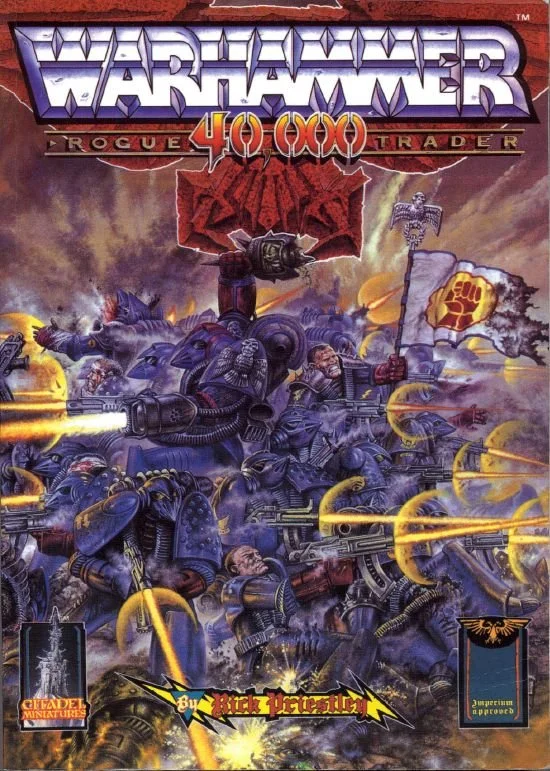
Going back to the start of anything is always an odd affair. Warcraft: Orcs and Humans has very little in common with the evolution that brought us whatever the hell World of Warcraft is these days. The first Fast and the Furious film is tonally unlike the insanity Fast Ten* had going for it. That same is highly true of 40k’s start. Not the Horus Heresy or even the War in Heaven, but the first book published in 1987. Warhammer 40000: Rogue Trader is a truly fascinating read as, with four decades of hindsight, we witness the foundations of one of the most lucrative and successful fictional universe outside a certain Space Wizards trilogy. What is rather less obvious is that the people putting it together probably had rather less idea of what they were building than we might imagine. It’s a big, almost intimidating collection of rules, illustrations and possible background material assembled by a team who had carte blanche to throw everything they liked into a single volume. I say possible because the galaxy as presented here is just what the Studio Team were playing with, and the idea of Rogue Trader’s universe is not concrete. Make it as you please. Create the galaxy you want. It’s an excuse to have science fiction metal men on the table to shoot each other alongside the muddy fantasy setting they were also developing at speed. It’s part wargame, part RPG, part anthology and mostly a reason to get really weird art made. It often has no idea what it wants to be and thats a feature, not a problem. Looking back, it’s difficult not to appreciate just how different it was from the game that would eventually grow out of it.
The first thing that strikes you is how much of the book isn't actually concerned with fighting battles. Modern Warhammer 40,000 is, for all its extensive background material, primarily a game about armies smashing into one another. Rogue Trader, on the other hand, spends an extraordinary amount of time establishing the universe in which those battles might take place. The Age of the Imperium is presented as a vast, oppressive and deeply unpleasant future, where humanity has managed to survive the collapse of civilisation by building something arguably worse in its place. The Emperor rules over an empire of unimaginable scale, its bureaucracy is incomprehensible, its religion is absolute, and its citizens are generally expected to accept that their lives are of considerably less importance than the continued existence of the Imperium. It is an immediately recognisable setting, although not quite the one we know today. The Gothic architecture, the religious fanaticism, the endless wars and the institutionalised cruelty are all there, but they're mixed with a distinctly different sort of science fiction sensibility. There is a little* 2000 AD, a little Dune, a little Michael Moorcock, and quite a lot of the sort of wonderfully peculiar British science fiction that seemed to thrive in Thatcher’s Eighties. It isn't yet the carefully layered mythology of modern 40K. It is something much more anarchic, a universe in which almost any ridiculous idea can be accommodated provided somebody can come up with a sufficiently convincing reason for giving it a weapon.
And ridiculous ideas there are aplenty.
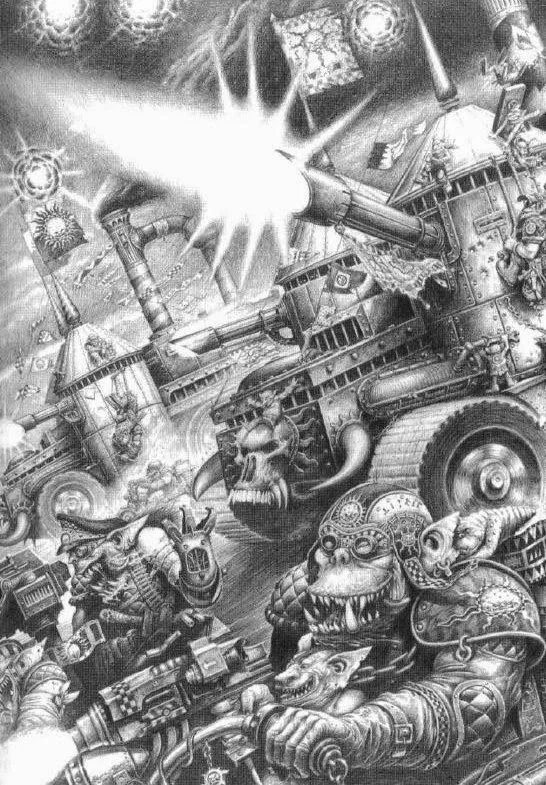
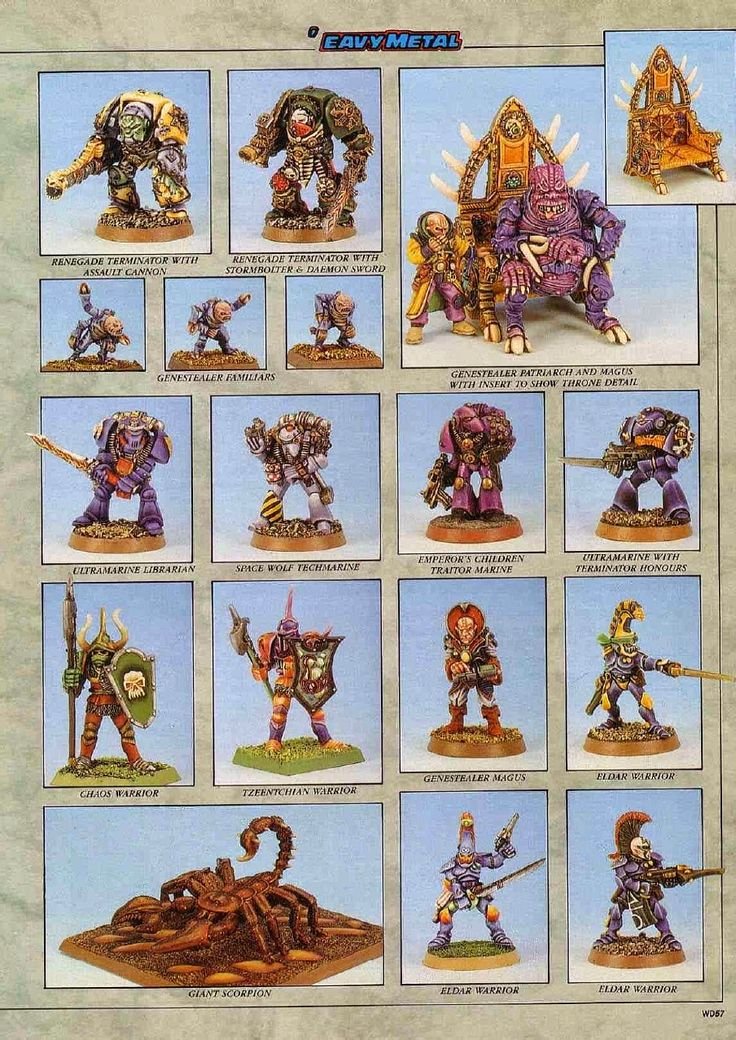
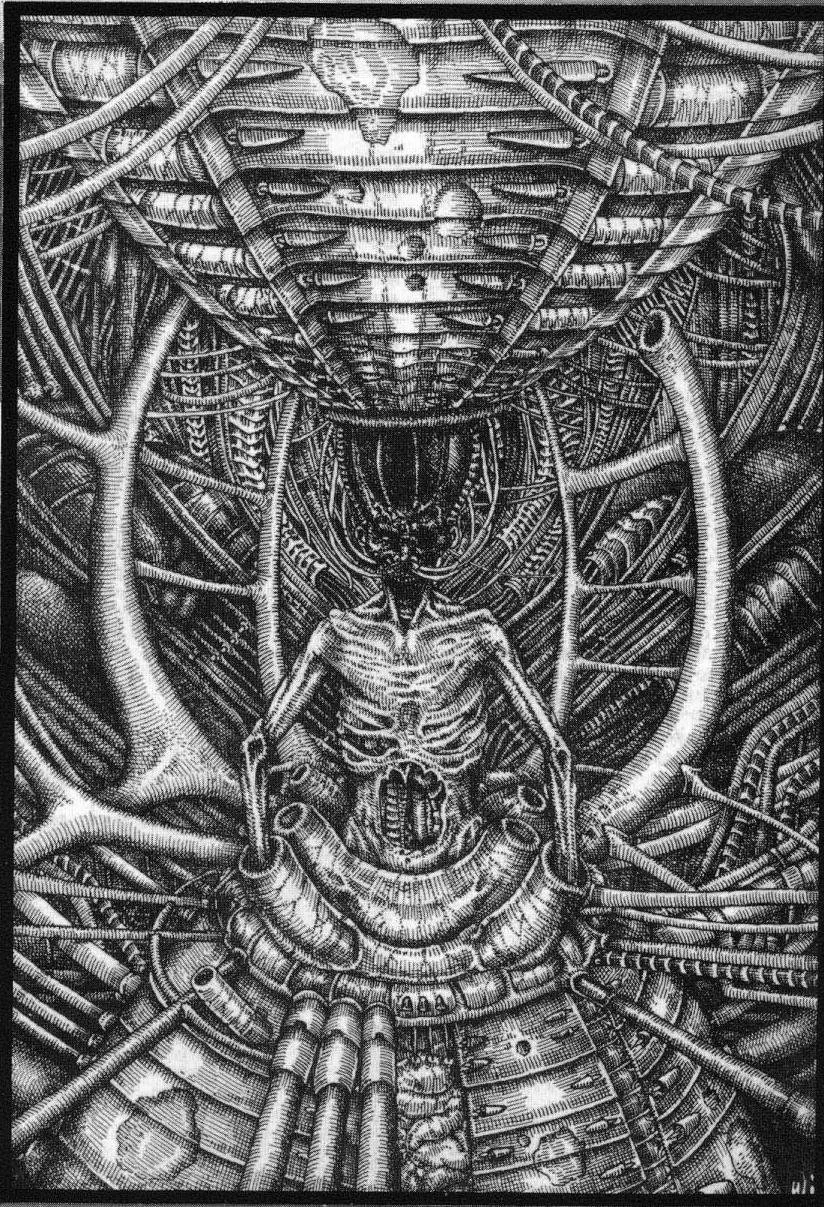
The Imperium is not presented as some shining bastion of civilisation fighting against the darkness. It is frequently just as monstrous as the things it fights. It is a brutal corrupt institution with an attitude towards the alien is generally somewhere between suspicious shooting and immediate extermination. The phrase 'there is only war' would eventually become the defining description of the setting, but the original book has a rather more mischievous quality to it. There is a black humour running through the background, an understanding that the whole business is quite absurd, even when the consequences for the unfortunate people involved are rather serious. The universe is simultaneously terrifying and faintly ridiculous, which is a combination Games Workshop would become exceptionally good at exploiting. The aliens are an interesting reflection of this early approach. Orks are recognisably the troublesome green menace they would become, although their character and appearance still have a distinctly different flavour. The Eldar are already burdened by the remnants of an ancient civilisation, while Genestealers are a far cry from the Tyranid organisms they would become. There is also a much broader assortment of strange creatures***, unusual factions and peculiar technological developments than a modern player might expect. The universe feels less settled, less categorised and considerably more open to experimentation. Not everything has a place in a grand narrative, and not everything needs to be explained through several hundred pages of codex background.
This openness is reflected in the game itself. Rogue Trader wasn't really designed around the enormous battles that would eventually become synonymous with Warhammer 40,000. It was a skirmish game, with relatively small numbers of individual models, each potentially possessing their own weapons, equipment, abilities and characteristics. There was a much stronger emphasis on the individual characters involved, rather than simply treating them as anonymous members of a regiment or unit. Personalities could develop, acquire equipment and become rather more important than their original points value might suggest. The rules also included a referee, or Gamesmaster, whose job was to oversee the proceedings and help manage the narrative elements of a game. In other words, it had considerably more in common with the roleplaying games of the period than the mass-battle wargame we might associate with the Warhammer 40,000 name today. This wasn't particularly surprising given the background of the people involved. Games Workshop had spent much of the preceding decade immersed in roleplaying games, fantasy miniatures and traditional wargaming, and Rogue Trader feels like a natural extension of that particular mixture. The distinction between playing a wargame and playing a roleplaying game was considerably less rigid than it would eventually become.
The titular Rogue Traders provided a particularly useful excuse for all of this. These were independent agents of the Imperium, granted extraordinary authority to venture beyond its established borders, explore unknown regions, establish trade routes and claim territories in the Emperor's name. They were explorers, merchants, adventurers and, depending on the circumstances, rather enthusiastic imperial colonialists. Their existence provided a convenient narrative explanation for why a small group of Imperial personnel might find themselves investigating an abandoned space station one week, negotiating with an alien civilisation the next, and shooting something with far too many teeth shortly afterwards. It also meant that the setting didn't need to be restricted to the familiar battlefields of the Imperium. There was an entire galaxy available for players to explore, and very little reason to assume that any two games should look alike. There is something rather appealing about that original proposition. Modern 40K has become an extraordinarily elaborate setting, with its own established timelines, historical events, political structures and increasingly complicated relationships between its various factions. The original Rogue Trader was much more comfortable with uncertainty. The galaxy was enormous and full of things that might be dangerous, useful or a mixture of the two. It was a place for adventure as much as warfare, and the rules reflected that. You could play a small-scale military engagement, but you could also create something considerably stranger. The Gamesmaster could introduce unexpected events, alter the circumstances of a mission or simply decide that the players had made a sufficiently poor decision to deserve whatever happened next.
Of course, the game wasn't perfect. Anyone who has spent time with the original rulebook will know that it can be a rather bewildering experience. The rules are sprawling, the presentation is occasionally eccentric, and the sheer number of optional systems and additional ideas can make it difficult to work out precisely what sort of game you're supposed to be playing. It is a book full of enthusiasm, but enthusiasm and clarity are not always particularly close companions. There is a certain charm in the idea that a referee might be required to adjudicate some of the more complicated situations, although I suspect that charm would diminish rather quickly after the third disagreement over exactly how far somebody's particularly unusual weapon could shoot. And yet, that is also part of its appeal. Rogue Trader feels like a game that is still discovering what it wants to become. There are ideas everywhere, some of which would become central to the setting and others that would quietly disappear into the great Imperial archive of things that Games Workshop would prefer we didn't ask about. It is a snapshot of a creative process rather than a finished product, and that makes it rather more interesting than a simple historical curiosity.
As the game developed, the balance gradually shifted. The second edition of Warhammer 40,000, arriving in 1993, moved further towards the army-based wargame that would define the franchise for decades. The individual personalities and narrative freedom of the original were increasingly supplemented by structured units, army lists and more formalised battlefield rules. This wasn't an overnight transformation, and the material produced between editions continued to explore the possibilities of the setting, but the direction of travel was becoming clear. Warhammer 40,000 was growing up, getting bigger, and becoming rather more concerned with the business of arranging several hundred pounds' worth of plastic and metal into mutually hostile formations. The setting grew with it. The early, sometimes anarchic science fantasy of Rogue Trader gradually developed into the more recognisable mythology of the grim darkness of the far future. The Horus Heresy became an increasingly important part of the history, the Space Marines acquired more of their familiar identity, and the various alien factions became more clearly defined. What had once been a relatively open universe of strange possibilities became an increasingly interconnected fictional history, supported by novels, supplements, codices and an expanding range of miniatures. The process was not always consistent, and anyone who has spent time trying to reconcile older background material with modern lore will appreciate that the Imperium's historical records are apparently maintained by people with a very flexible understanding of chronology.
Interestingly, the Rogue Trader name eventually returned in a rather different form. In 2009, Fantasy Flight Games released Rogue Trader, a roleplaying game that took players back to the idea of exploring the Imperium's vast and dangerous frontiers. This time, however, the emphasis was firmly on character development, narrative and the lives of those operating beyond the relatively comfortable boundaries of Imperial civilisation. It was a rather fitting return for a name that had always carried a little more adventure and uncertainty than the main Warhammer 40,000 game. Looking back, the most interesting thing about Rogue Trader is not necessarily how much of modern 40K it got right. It is how much of it was allowed to be different. The original game was a peculiar hybrid, borrowing freely from roleplaying, science fiction, fantasy and miniature wargaming. It was occasionally clumsy, sometimes bewildering and possessed of an almost limitless capacity to introduce another bizarre weapon, alien creature or questionable piece of Imperial bureaucracy. But it also had an enormous sense of possibility. It didn't feel as though the universe had already been mapped out and all that remained was to fight over the bits. It felt as though there was still plenty to discover.
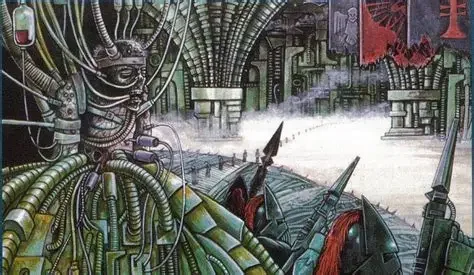
Perhaps that is why the original book remains so interesting. We know what happened next. We know about the Primarchs, the Great Rift, the endless wars, the increasingly elaborate histories of the various factions and the extraordinary commercial machine that Warhammer 40,000 has become. We know that the little skirmish game published in 1987 would eventually become a global phenomenon, supporting novels, computer games, roleplaying games, films-in-development and enough plastic miniatures to construct a reasonably convincing scale model of the Imperial Palace. But none of that was inevitable when Rogue Trader first appeared. It was simply a rather ambitious book full of ideas, written by people who clearly loved the sort of things they were putting into it. Somewhere between the rules for shooting things, the peculiarities of Imperial society and the illustrations of gothic spacecraft, Games Workshop had stumbled upon something rather special. They had created a universe that was sufficiently large to accommodate almost anything, sufficiently strange to remain interesting, and sufficiently flexible to keep changing long after the original game had been left behind.
Whilst it’s not better than what came later, it is vastly more interesting to build out the corners of half a map that to be hemmed in by it
As always, I remain
Adam
*Your seatbelts
*When I say little, I mean oodles. Possible gallons.
***SPACE. VAMPIRES. LIFEFORCE STYLE SPACE VAMPIRES.