Sunday Musings - But What Is A One Eyed Bog Lizard?
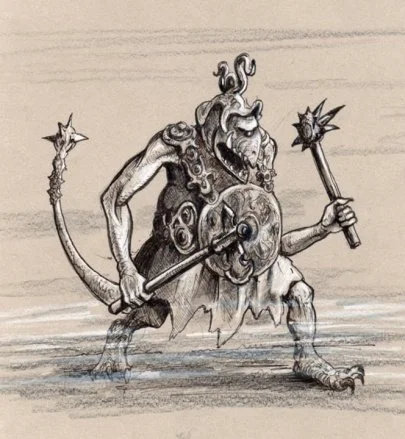
There are strange creatures lurking in the boggy backwaters of Warhammer’s history. Things half-remembered, half-beloved, and half-buried for crimes of lore, sculpting, or existing slightly too enthusiastically.
Few embody all three halves quite as magnificently as the Fimir. They were born in that wonderfully anarchic period of Games Workshop creativity in the late 1980s, when designers seemed to exist in a perpetual state of “What if…?” and nobody had yet invented the department whose job it is to say “Absolutely not.”
The Fimir first slithered into Warhammer during 3rd Edition: one-eyed, reptilian, mist-haunted bog monsters with tails, snouts, and a single glaring eye that suggested cyclopean heritage and questionable evolutionary choices. Physically, the early sculpts were unmistakable—hunched, muscular, and slightly hunched in amanner that spoke of how the sculptor clearly had a vision but also a rapidly approaching deadline. They were inspired by Celtic myth, particularly the Formorians, monstrous, mist-shrouded raiders who dwelt in fens and marshes and had a worrying fondness for ancient curses. In theory, they were meant to be a major new Warhammer race, unique and atmospheric. They were meant to be for WHFB what the Beholders or Mind-Flayers were to D&D, bespoke and unique
In practice several things went wrong simultaneously, and the first, least controversial one was their scale.
The original metal Fimir models were sculpted at a size that did not correspond neatly to anything in the Warhammer Fantasy Battles rules at the time. Too large to be infantry, too small to be true monsters, they wobbled awkwardly in a mechanical limbo, especially since 3rd Edition was heavily dependent on precise unit types. They looked like they ought to have two Wounds, but they were mounted on bases that suggested one. They were listed as “man-sized” in some contexts, but physically towered over actual humans like a very confused ogre who had been put through a hot wash. Their tails, sculpted lovingly and at considerable length, made ranking them up in units an exercise in geometry, elastic patience, and occasionally bending metal with your bare hands. No two people anywhere in the world could quite agree how many could fight in a rank, how many attacks they should have, or how precisely they fit into the game’s ecosystems of infantry, cavalry, and things that ruin cavalry.
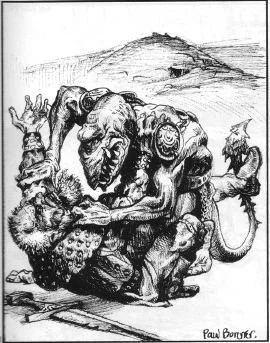
It did not help that the rules gave them a narrative importance that their battlefield performance simply couldn’t match. They were intended to be a major, fearsome faction—swamp tyrants, mist-wreathed warlords—but on the table they operated somewhere between “oddly tall skirmishers” and “monsters with an identity crisis.” They were the earliest example of the “cool concept, weird stats” problem.
Then, of course, came the bigger problem—the one that truly killed their chances of becoming a mainline army. The early lore included a deeply inappropriate reproductive element involving abducting human women. Even at the time, this wasn’t just eyebrow-raising; it was a full-body “no, absolutely not” moment. The designers had tried to borrow from certain strands of dark folklore, but folklore is not always the most advisable source of family-friendly fantasy gaming. What might have been written as “grim mythic flavour” landed firmly in the domain of “please remove that from the vicinity of any game aimed at teenagers.”
This combination—the inappropriate lore and the awkward sculpt-to-rules mismatch—meant that the Fimir’s days as a promoted race were numbered almost from the moment they ooze-slithered onto the stage. They appeared in HeroQuest, where the scale mismatch was still noticeable but at least consistent within that board game’s ecosystem, and they received a few mentions in bestiaries and scenario packs, but they never gained traction. You can almost imagine the studio having a meeting about the Fimir in which someone said, “We have two problems,” and everyone agreed that the second one (the lore) was vastly more urgent, but the first (the scale) was doing them no favours either.
By 4th Edition, the Fimir were already fading away. The rules of the time had become tidier, the model ranges more disciplined and the worldbuilding more constrained. The Fimir simply didn’t fit within The Old World, physically, mechanically, or narratively. They were retired quietly, without fanfare, without an in-world extinction event, simply left to sink into the mists from which they came. The sculpting moulds went quiet, the lore books replaced them with safer swamp denizens, and the fandom responded with a mixture of bemusement and the occasional fond lament.
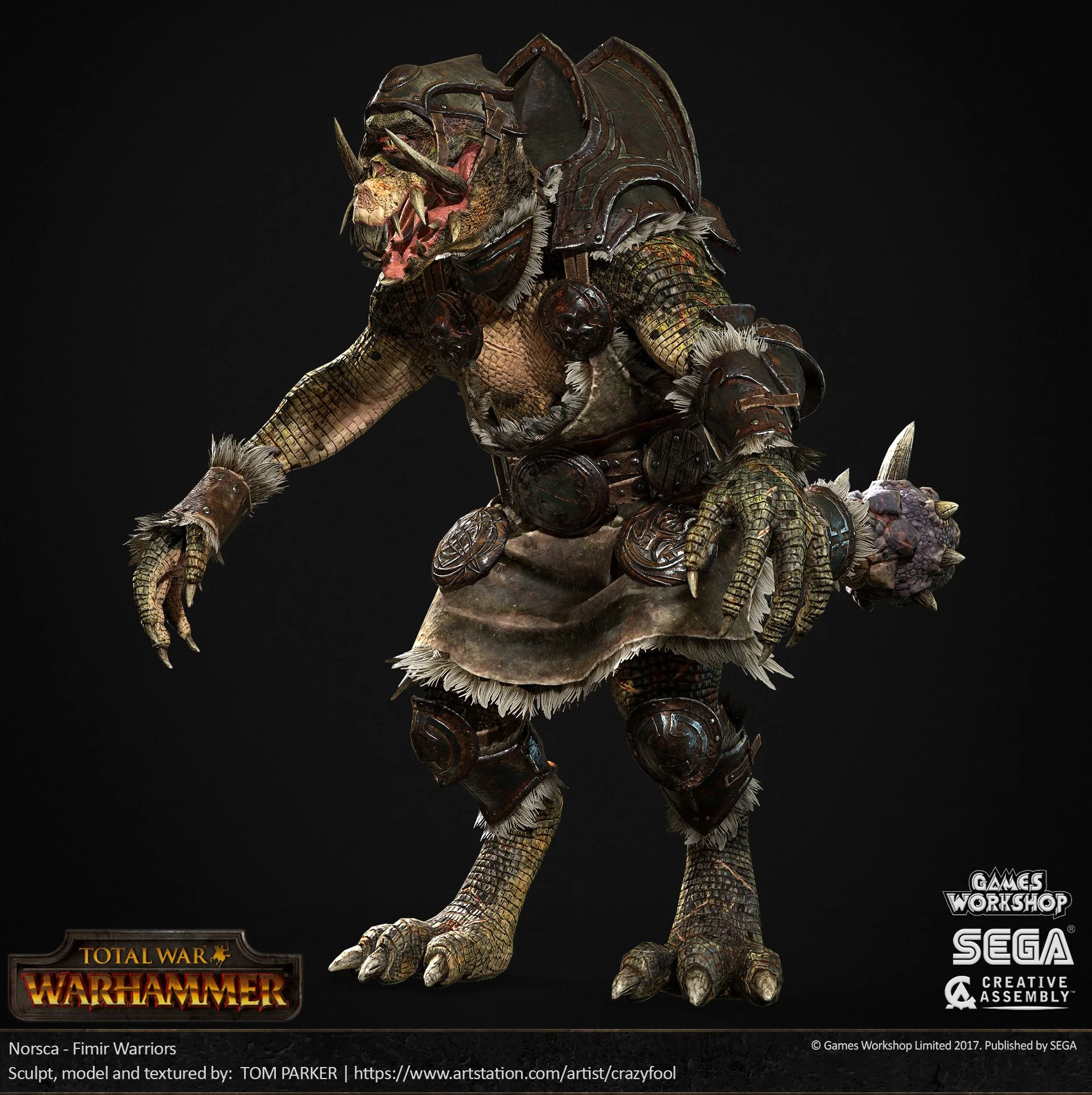
And yet, like all good swamp creatures, the Fimir never truly die. Hobbyists kept a candle burning for them* . Their aesthetics were too good to forget. They resurfaced decades later through Forge World’s Monstrous Arcanum as Fimirean, redesigned with far better proportions, a much clearer battlefield role, and, critically, none of the problematic reproductive background. The new models looked powerful and mythic. These new Fimir were taller, heavier, more cohesive, less awkwardly hunched. They finally lived up to the image that the original lore had tried to evoke without tripping over narrative landmines. Total War: Warhammer brought this design into the PC game with much fanfair and lauded reactions.
Age of Sigmar, with its broad realms and willingness to host all manner of strange beings, welcomed this updated version as rare, ominous bog terrors, servants of shadowy powers, mist-walkers, and devourers of the unwary. Their background became atmospheric rather than scandalous, built around ancient curses, shamanic fogcraft, and long-forgotten pacts. It's a shame they have stayed so far in the background as they have.
And so the Fimir remain one of Warhammer’s oddest historical footnotes. Creatures born with promise, undone by a combination of unsuitable lore and unsuitable physical design, then rescued decades later in a new form that finally captures what was good about them in the first place. They are a testament to the idea that even the strangest concepts can find redemption with the right blend of sculpting skill, narrative refinement, and careful excision of disastrous 1980s decisions. See also the Ambull.
The Fimir are poised to return when the urge strikes the design studio. The Isle of The Fimir has been in every map of Ghur since 1st Ed, and since the Hellsmits now exist, all bets are off on how Age Of Sigmar fixes and returns the Fimir** to tabletops.
As always, I remain
Adam
*usually while trying to glue a tail back onto one
**You can buy some truly awesome Fimir at Fomorian Raiders – Krakon Games