SUNDAY MUSINGS - A VESSEL IS BORN ANEW
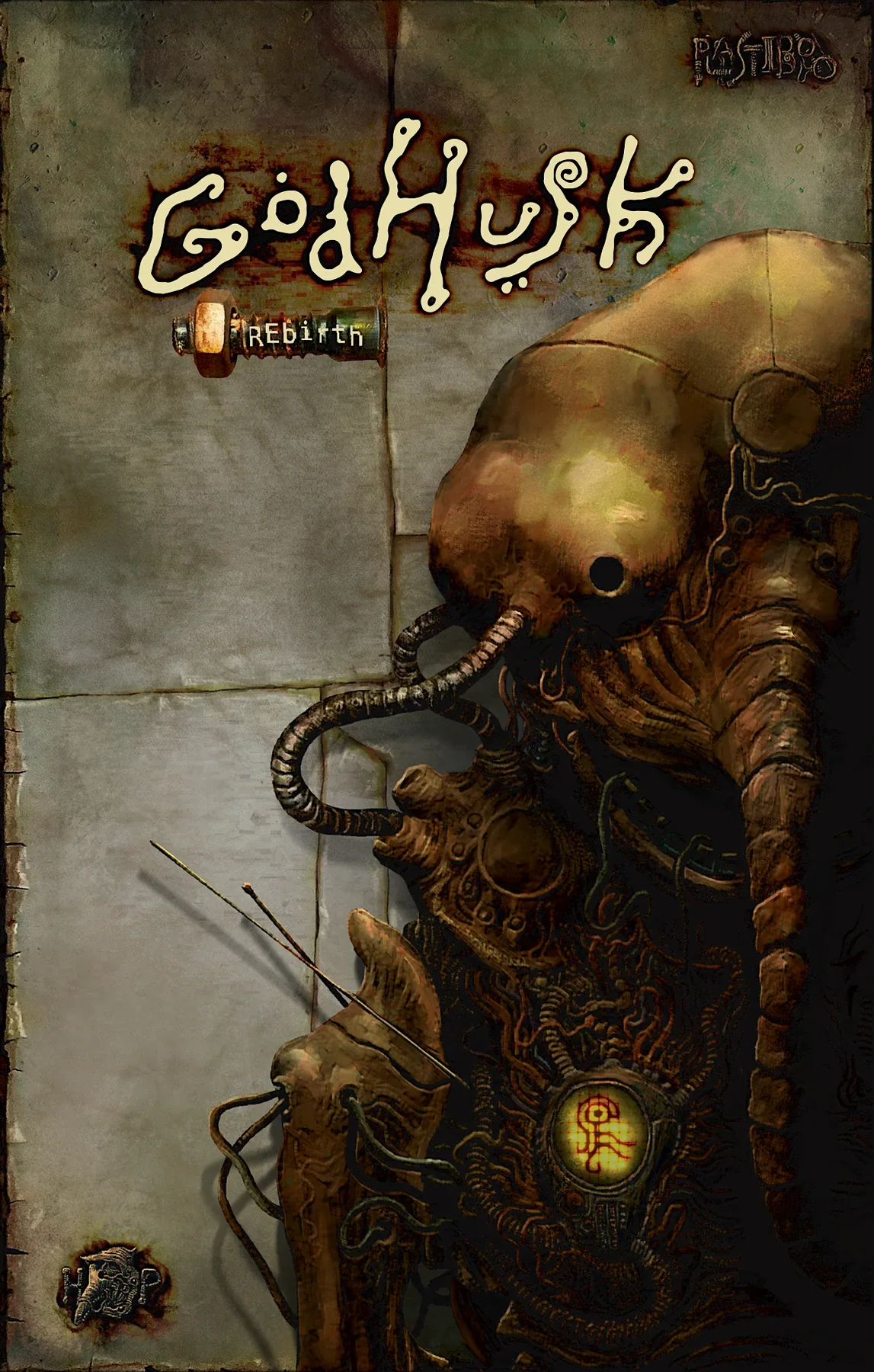
It's this sincerity that elevates Godhusk beyond a clever gimmick. The closest literary comparison is undoubtedly House of Leaves, another work built around a fictional piece of media whose complete internal consistency becomes more persuasive than reality itself. Where Danielewski explored obsession through intense, metamorphosing text, Plastiboo explores memory through videogames, and more specifically through the culture that surrounded them. This isn't simply a fictional game; it's a fictional history set within a fictional game . Every page evokes magazine previews, playground rumours, late-night internet forum debates, official strategy guides with contradictory information and the peculiar archaeology that develops around cult classics. The book creates the mental imagery of what it would feel like to remember playing it.
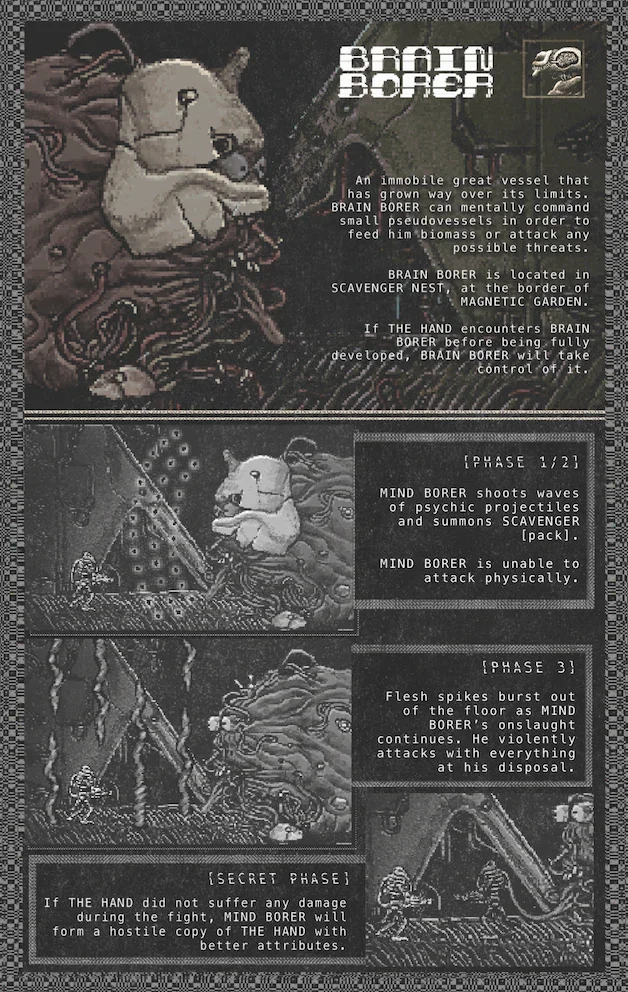
Visually, Plastiboo continues to prove that they're one of the most distinctive horror artists working today. Their work inevitably invites comparisons to H. R. Giger's biomechanical nightmares, the decaying melancholy of Silent Hill, the oppressive grandeur of Dark Souls and the industrial body horror of Scorn, but those influences are ingredients rather than destinations. Pixel art and painstaking illustration exist side by side without ever feeling inconsistent, creating environments that appear to have grown rather than been built. Flesh and machinery become indistinguishable, architecture develops organs, and every surface carries the damp, diseased texture of a world that has long since forgotten the difference between the organic and the mechanical. The images demand to be studied because they refuse to surrender everything at first glance, rewarding repeated examination with details that seem almost impossible to have overlooked the first time.
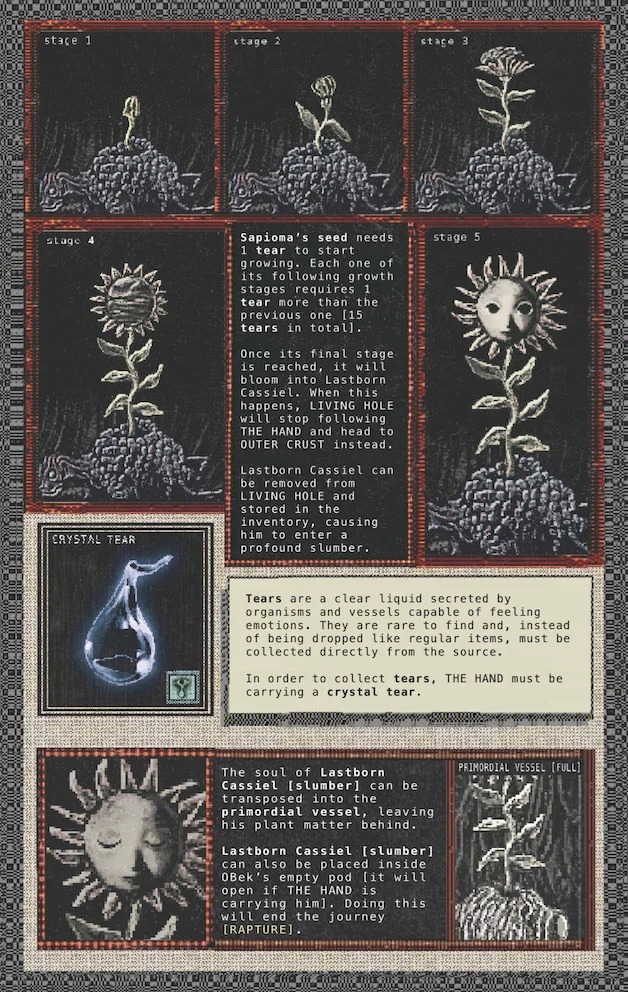
There was a time when strategy guides were almost as exciting as the games themselves. Long before YouTube walkthroughs, wikis and Discord servers had reduced every mystery to a thirty-second answer, we'd happily spend evenings leafing through hefty Prima and BradyGames tomes, studying maps of worlds we hadn't yet explored and committing boss strategies to memory weeks before we could afford the game. Those books occupied a strange place somewhere between manual, art book and promise, allowing us to inhabit a game's world even when the console was switched off. Godhusk: Rebirth understands that feeling intimately, and rather than merely recreating it, Plastiboo twists it into something wonderfully unsettling. They've produced an official strategy guide for a game that has never existed, and somehow, against all logic, your brain starts insisting that perhaps it did.
The remarkable thing is that Godhusk never behaves like a parody. It never winks at the reader nor lean on the joke that none of this is real. Instead, it presents weapon descriptions, quest solutions, NPC interactions and hidden endings with an authetic unwavering confidence. Characters are referenced without introduction, locations are discussed as though you've already struggled through them, and obscure mechanics are explained with the expectation that you're already invested in mastering them. Within a few pages you begin manufacturing memories that aren't yours. Was this an obscure Japanese PC title? A cancelled Dreamcast exclusive? One of those strange PlayStation 2 horror games everyone suddenly remembered twenty years later? Rationally you know none of that is true, yet the presentation is so convincing that you find yourself searching your own memory for a game that history forgot rather than one that was never made in the first place.
Where Vermis felt like an excavation into forgotten fantasy, Godhusk is markedly more philosophical. The monsters remain grotesque, but they increasingly feel like symptoms rather than subjects. Beneath the impossible weapons, bizarre NPCs and unnerving creature design lies a meditation on collapse, faith and meaning. What remains when civilisation has already failed? Can hope survive once the world has become fundamentally hostile, or does optimism merely become another form of denial? If there is a higher power, has it abandoned humanity, or has humanity simply ceased looking upward? Plastiboo never pauses to ask these questions outright. Instead, they emerge naturally through item descriptions, environmental storytelling and seemingly mundane gameplay instructions. A quest involving the incubation of an egg quietly becomes a meditation on sacrifice. A weapon description hints at theology. A fragment of dialogue raises questions that echo for chapters afterwards. The book consistently trusts the reader to recognise significance without underlining it, a confidence that feels increasingly rare in contemporary storytelling.
That trust transforms reading into exploration. Like the finest horror games, Godhusk rewards curiosity rather than completion, encouraging constant re-evaluation as new discoveries cast earlier pages in an entirely different light. Symbols recur with altered meanings, locations begin revealing hidden relationships, and throwaway details gradually expose themselves as fundamental pieces of a much larger puzzle. It is impossible to read straight through without occasionally turning back several pages to confirm a suspicion or reinterpret an earlier encounter. The guide becomes a game in itself, asking the reader to investigate rather than simply consume, and in doing so captures the feeling of genuine discovery that so many modern games, burdened by objective markers and exhaustive tutorials, struggle to recreate.
Perhaps the most remarkable achievement is the book's restraint. Modern horror often mistakes explanation for depth, convinced that every mystery must eventually be solved and every symbol decoded before the credits roll. Godhusk refuses that temptation completely. Its ending offers implication instead of certainty, leaving the reader not frustrated by unanswered questions but energised by them. Long after closing the book you'll continue assembling theories, reconsidering earlier pages and wondering whether the final images have subtly recontextualised everything that came before. Very few books earn a second reading immediately after the first. Fewer still do so because they have convinced you that the answers were there all along, quietly waiting for you to notice them.
More than anything else, Godhusk: Rebirth understands that horror is rarely about monsters. Horror is uncertainty. It's the creeping suspicion that your memories are unreliable, that your understanding of the world is incomplete, and that somewhere in the recesses of your mind you can almost remember fighting a boss that never existed in a game that was never released. By the time you reach the final page, Plastiboo has accomplished something genuinely extraordinary. They haven't simply built a fictional world. They've built the memory of one.
If Vermis proved that Plastiboo had stumbled onto something special, Godhusk: Rebirth confirms it wasn't an accident. This is one of the most inventive horror books published in recent years, an art book, philosophy text, strategy guide and act of collective false memory rolled into one grotesquely beautiful artefact. You'll close it absolutely convinced that somewhere, buried in an old gaming magazine or forgotten on a dusty hard drive, Godhusk really did exist.