Sunday Musings - Nostalgiacraft
There’s a smell to nostalgia that’s often hard to quantify. It changes from person to person, it’s an abstract, yet potent experience born from the journey that each of us has been on. Yet we can all agree on the intoxicating pull it has on us all. The sound of a hardback book creaking open, releasing a slightly musty smell. It’s a reminder of a time when we were younger, when our external worlds were smaller and so our internal ones could grow unchallenged. It’s a quiet, persistent tug to the pillars of days passed that occupied central, almost sacred, space in your life.
The Tabletop industry has spent the last decade rediscovering how much power those feelings can have. Which, in a way, can be viewed as almost amusing. For a long stretch of years, Tabletop companies pushed forward with a zealot’s fervour, birthing new systems and IPs, mechanical gimmicks to differentiate and stand above the crowd. Audiences did indeed grow, especially over the now-half decade ago pandemic of 2020. But somewhere under the surface, the game-smiths realised that drawing in the new was great, but they were losing the wallets of the old. It happens in all walks of life, people age, responsibilities change and the hobbies harder to justify the price and time against making sure the bills are paid and the washing machine works. The outer world outgrows the inner.
The interesting part here isn’t that nostalgia is baited to recatch the lapsed, which we have seen in the stylings of Mattel and Hasbro, who forgot for a long time that keeping the older consumer in the fold was always going to be a shrinking market without calling to the newer, younger buyers. Tabletop companies are not trying to remind people that tabletop is fun, but reminding them of how fun. Direct comparisons can be made to current GW sculpts to Mark Gibbons artwork (among others). The games themselves may be modern, but look to the design philosophy of indie games like Turnip/Swill or Necropolis.
It is telling that companies have begun mining their own histories (and adjacent histories ) for any of us who grew up in the 80s have been left with the concept of an IP having weight, something that is hard to shift over the decades. Avalon Hill’s successful Heroquest revival has crossed the streams by updating older material as well and providing brand new expansions. OPR’s Star Quest has opened the dormant vein of Space Crusade. These are all not simply revival’s for revival’s sake but reaching back to bring forward worlds that resonate with the players,
Now all this comes to a head with what may be the most promising or disappointing crux of this movement. Where the nostalgia isn’t revisiting old editions or relaunched some beloved world, rather a translation of nostalgia over mediums.
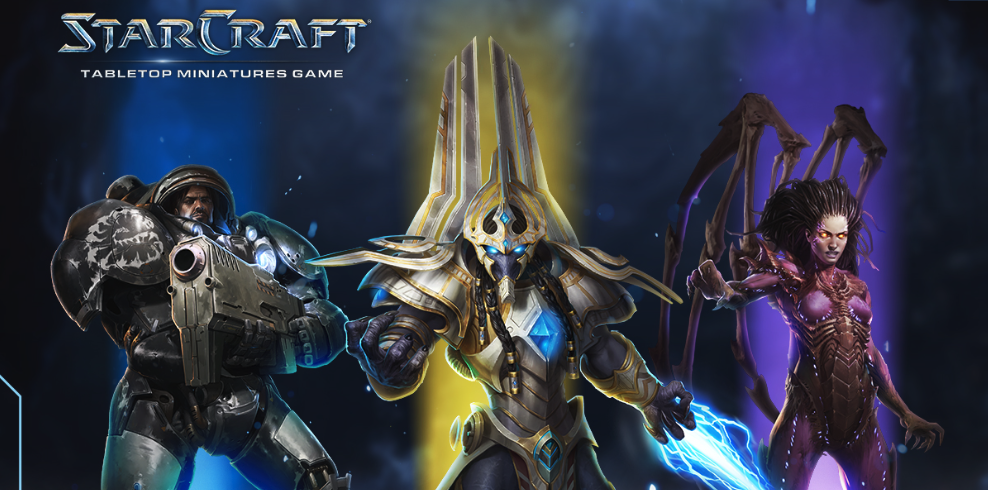
Archeon’s Starcraft tabletop sits firmly in this area. Starcraft is fundamentally a cornerstone in the history of PC gaming, a foundational text in gaming culture. It harkens back to when Blizzard were untouchable, and created the finest RTS experiences, with strong narratives and a ton of humour to boot. It’s connected to the concept of competitive strategy so firmly that when added to any tabletop hobbyist's Venn diagram, it’s so close to being a circle it may as well just be one. The forces of the Terran, the Protoss and the Zerg are embedded in the meme-culture so prevalent in the internet. The first Starcraft game was released in 1995. The last one was in 2015. Talk persists of how this may be a move a decade too late.
Excitement has built to the release, but it feels bridled. There appears to be an undercurrent of hesitation alongside the joy, scepticism mixed in the with the want. The recurring sentiment that Starcraft’s peak cultural relevance lies behind us now. Yet, nostalgia is never tied to a timeline, instead being connected to what was personally formative. Archon Studios appear to be aiming firmly for those of us for whom Starcraft was as much a defining experience for us as it was for them, those first steps into ESports, the late night LAN matches. But has too much time passed to make it viable?
Translating a digital experience to meat-space, especially something as fast paced and mechanically intricate as Starcraft, is no small effort. It always thrived on the speed, precision and constant motion of the player, making split second decisions under pressure and managing the multiple layers of troop information simultaneously. Nothing there maps cleanly onto the tabletop, where a much slower, deliberate pace is maintained.
However, it does appear to have managed to capture the faction identities perfectly, everything feels “right” in the brain-feel, even in the underlying mechanics have changed dramatically. The recreation of Starcraft on the tabletop cannot be slavish to the mechanics, but that the brain-feel in right. Protoss need to feel elite and powerful. The Terrans backfooted but adaptable. The Zerg an overwhelming organic wave. If this can be done, then Starcraft can push past it’s history and start building a new future for itself.
The double edged sword of Nostalgia comes into play here. It could just as easily cause a retroactive issue with the IP as it can elevate it to greater heights. Nostalgia is an amplifier, whatever the final result will be, it will be pushed to greater results for good or ill. Nostalgia for a long time has been traded upon like a safety net, to guarantee interest and reduce risk. It feels like that is becoming less the last the further into the 2020’s we crawl.
It’s close to impossible to evaluate StarCraft the tabletop game on it’s own merits when those formative memories reside in you. It’s not purposeful, but the very nature of what it is means you are comparing it to an idealised version of what you played. Thus the very best it can do is come close to trigger the right recognitions, to bridge between then and now, and to have enough under the hood to build forward motion all of it’s own.
I hope it does well, I honestly do. The experiment here of seeing if nostalgia can, in the year 2026, stretch the emotional core of a mid 90s RTS into a two decades post millennium tabletop. More broadly, it reflects how industry views are looking to the future in all walks. Innovation has not truly disappeared, but is framed by a familiar lens. Anything new is wrapped in the language and aesthetics of the old.
The success hinges on something very hard to quantify and impossible to manufacture. All that is good about it, all the work that went into the ruleset and sculpting will live and die on how it connects to the audience, and I hope it finds enough of a new one alongst reminding the old of what they loved, to live a long and newer life