Sunday Musings - Out With The Old, In With The Sigmarines
Before Age of Sigmar there was Warhammer Fantasy Battles, first published in 1983, a rank-and-flank mass battle game that grew over three decades into something far denser than its original creators likely imagined. What began as a relatively loose fantasy wargame inspired by roleplaying sensibilities and historical miniatures design slowly accumulated layer upon layer of lore, mechanics, retcons, and tonal shifts. By the time Sixth Edition arrived in 2000, shepherded by designers like Rick Priestley and later Alessio Cavatore, the Old World had cohered into a setting with its own political geography, theological disputes, and centuries-long grudges. Army books did not merely provide rules but embedded timelines, unreliable narrators, and campaign aftermaths that were not always fully reconciled with one another. The setting felt contradictory because it had been written by dozens of authors across decades, and that inconsistency gave it texture.
Sixth Edition is often remembered internally within the studio as a deliberate tonal reset after the excesses of Fifth. The design team tightened the rules, darkened the art direction, and emphasized grounded factions like the Empire and Dwarfs over the more flamboyant high fantasy of earlier years. Sales during this period were stable but increasingly pressured by changing retail realities. By Seventh and especially Eighth Edition in 2010, the business model was leaning heavily on large centerpiece kits and bigger army sizes. Eighth pushed massive infantry blocks, random charge distances, and devastating magic phases powered by handfuls of dice. The spectacle was undeniable, but the average model count per army climbed, and with it the cost of entry. Behind the scenes, Warhammer Fantasy was consistently outsold by Warhammer 40,000, sometimes dramatically so, and independent retailers often reported that Fantasy boxes moved slower and required more shelf space.
The structure of the rules also created commercial friction. Because army books were released sequentially over years, internal balance fluctuated wildly depending on publication date. An army book written late in an edition cycle often outperformed earlier ones, and updating them all simultaneously was logistically difficult. The company’s leadership during the late 2000s and early 2010s was increasingly focused on intellectual property control, direct retail, and higher margins per kit. Large ranked regiments required many identical miniatures, but they were less visually distinct as premium products compared to characterful multipart heroes or monsters. Internally there was growing recognition that the rank-and-file model constrained both design space and profitability.
The End Times emerged from that environment. Beginning in 2014 with The End Times: Nagash, followed by Glottkin, Khaine, Thanquol, and culminating in The End Times: Archaon in 2015, Games Workshop did something it had historically avoided. It advanced the global timeline in a way that could not be walked back. For decades the setting had existed in a kind of suspended catastrophe, always on the brink of Chaos but never falling. The End Times shattered that stasis. Major characters were killed permanently. The world map itself was torn apart. The campaign books were accompanied by enormous new kits, including a reimagined Nagash and a towering plastic incarnation of Archaon, signaling visually and commercially that this was escalation without restraint.
Behind the scenes, former staff interviews and industry reporting suggest that the decision to end the Old World was not purely narrative ambition but strategic repositioning. The company wanted a setting it fully owned and could protect more aggressively as intellectual property. The Warhammer Fantasy world drew heavily from European history and folklore. The Empire echoed the Holy Roman Empire. Bretonnia drew from Arthurian myth and medieval France. Orcs, elves, and dwarfs were generic fantasy archetypes that were difficult to trademark. By contrast, the Stormcast Eternals, Orruks, and the more abstract Mortal Realms were distinctively branded creations. From a legal and marketing perspective, that mattered.
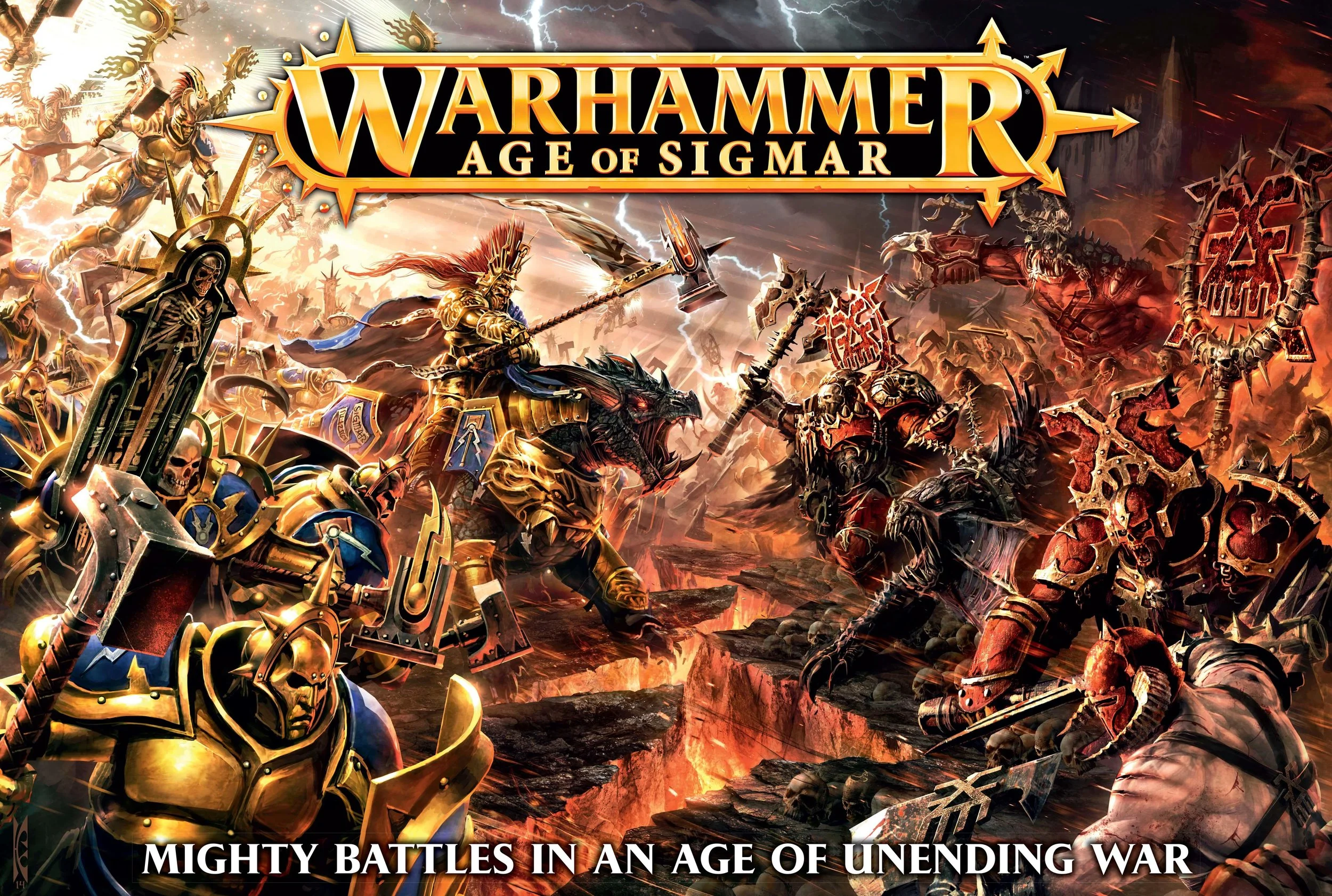
When Warhammer Age of Sigmar launched in 2015, it did so with startling minimalism. The core rules fit on a few pages. Warscrolls were free downloads. There were no points values. Internal design philosophy at the time favored accessibility and narrative freedom over competitive scaffolding. Leadership believed that rigid army construction and dense rulebooks had become barriers to entry. The assumption was that players would self-regulate balance through social contracts. That assumption worked in some home groups but faltered in stores and clubs where strangers needed a shared framework.
The backlash was immediate and loud. Longtime players felt blindsided by the destruction of the setting. Competitive communities struggled without points. Some early warscroll abilities were written with tongue-in-cheek mechanics that required players to shout or perform in-character actions, reinforcing the perception that the system lacked seriousness. Sales in the first year were reportedly mixed. At the same time, the simplified rules did lower entry barriers for new hobbyists, and the visual identity of the Stormcast Eternals proved commercially strong.
The Realmgate Wars campaign books began adding structure and lore depth. The Mortal Realms were conceptualized as vast elemental planes rather than a single mapped continent, giving designers nearly infinite narrative flexibility. The Stormcast were reframed not as flawless golden warriors but as tragic figures losing fragments of memory with each reforging. That thematic shift gave the setting emotional weight it initially lacked. Most importantly, in 2016 the General’s Handbook introduced formal points, matched play scenarios, and army construction guidelines. That publication was widely interpreted as a course correction. It demonstrated that Games Workshop, under newer leadership following corporate changes in 2015, was willing to respond to community feedback.
Second Edition in 2018 formalized mechanics such as command points and Endless Spells, adding tactical layers without reverting to the density of late Fantasy. The studio also adopted a more transparent communication style through community articles and previews, something that had been notably absent during the End Times transition. By Third Edition in 2021, Age of Sigmar had achieved competitive legitimacy with organized events, balanced battletomes, and a clearer internal identity. It no longer felt like an experiment replacing something beloved but a parallel pillar of the company’s portfolio.
In retrospect, the destruction of the Old World can be read as both a creative gamble and a corporate necessity. Warhammer Fantasy had become rich but commercially constrained, beloved but increasingly niche compared to its science fiction sibling. Age of Sigmar was born from that tension. It shed ranked regiments, embraced trademarkable iconography, and reset the mechanical baseline. Years of iteration transformed it from a shock to the system into a stable, successful game line.
The Old World itself has since returned in the form of Warhammer: The Old World, positioned as a specialist system that leverages nostalgia while coexisting with the Mortal Realms. That coexistence says something important. The End Times were not merely an ending but a restructuring. One setting carries the accumulated sediment of three decades of worldbuilding. The other carries the lessons learned from dismantling it. Both now stand as evidence that even in a hobby built on painted permanence, nothing is ever entirely fixed, and sometimes destruction is the price of reinvention.