
Sunday Musings - You Cannot Summarise John Blanche
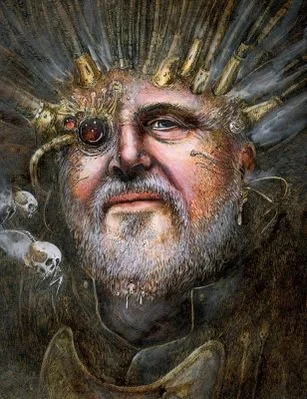
There have been no less that four attempts to write the In Memorium for John Blanche. Each one failed to capture anything about his work, or the man behind it. It's easy to simply point to the games, the books, the miniatures, and with a certain degree of confidence say, "There. That was their work." The task of an In Memoria is therefore relatively straightforward. One gathers the accomplishments, arranges them in roughly chronological order in a suitable amount of reverence, and everybody goes home satisfied.
John Blanche presents a rather different challenge.
The news of his passing has prompted an extraordinary outpouring of affection from every corner of the hobby. Artists, painters, writers, gamers, collectors and hobbyists who have not picked up a paintbrush in twenty years have all shared stories of the influence he had upon them. Yet the remarkable thing is that very few people seem to be talking about a specific painting, a particular illustration, or even a single project. Instead they speak about atmosphere. They speak about inspiration. They speak about the way his work made them feel. This is where any attempt to summarise John Blanche immediately begins to fall apart.
To describe Blanche as an artist is obviously correct, but it is no more complete than describing William Shakespeare as somebody who occasionally put words on paper. The statement is accurate, yet somehow misses the point entirely. His influence upon Warhammer was so profound and so all-encompassing that attempting to separate the man from the worlds he helped create becomes almost impossible. He was not merely depicting the setting. In many respects, he was teaching the audience how to see it. This may seem like an odd distinction, but it is an important one. Plenty of fantasy artists have created technically beautiful works over the decades. Their paintings are polished, coherent and often breathtaking in their execution. John Blanche's work frequently appeared to operate according to an entirely different set of principles. His worlds were crowded with impossible architecture, rusted relics, skeletal saints, bizarre pilgrims and machinery that appeared to function entirely through religious conviction and poor health and safety standards. Looking at one of his paintings often felt less like observing a scene and more like uncovering a half-remembered dream.
What made those images so powerful was that they rarely attempted to explain themselves. Modern worldbuilding often obsesses over logic. Every institution requires a flowchart. Every military organisation requires a spreadsheet. Every fantasy kingdom must apparently submit a detailed report regarding its agricultural output before the audience is allowed to take it seriously. Blanche understood something rather different. He understood that people fall in love with worlds because of atmosphere rather than logistics. Nobody remembers the Imperium because its tax collection system makes sense. They remember it because it looks like a medieval cathedral has declared war upon common sense and somehow won. The term "grimdark" has become almost inseparable from Warhammer over the years, and certainly Blanche's work played an enormous role in shaping that identity. Yet even that famous label feels strangely inadequate when discussing his legacy. Grimdark has become a genre descriptor, a useful shorthand that immediately communicates certain expectations to an audience. Blanche's work was never simply grim. There was beauty in it. There was absurdity in it. There was humour lurking in the margins. There was often a strange sense of melancholy. Looking at a Blanche painting could feel simultaneously inspiring and unsettling, rather like discovering a magnificent cathedral only to realise it has been constructed entirely from bad decisions.
What fascinates me most, however, is the way his influence escaped the confines of official publications and entered the hobby itself. Most artists inspire admiration. A smaller number inspire imitation. Very few inspire an entire philosophy of creativity. Yet that is precisely what happened.
Over the years, communities emerged that treated Blanche's work not as something to replicate but as something to interpret. The movement that eventually became known as Blanchitsu encouraged hobbyists to embrace imperfection, experimentation and narrative above technical precision. Strange conversions began appearing across the internet. Warbands emerged that looked less like armies and more like fragments of forgotten folklore. Pilgrims, mutants, scavengers and heretics marched across tabletops in paint schemes that often seemed actively hostile to conventional colour theory. Entire communities developed around the idea that a miniature should tell a story before it demonstrated technical proficiency. This was a profoundly important development because it represented something increasingly rare within modern hobby culture, in that there was the permission to be strange. To try to dabble in the weird.
We live in an age of tutorials. Every conceivable technique can be learned from a video. Every paint scheme can be reproduced step by step. Every army can be optimised. There is tremendous value in that accessibility, but there is also a danger. The pursuit of perfection can sometimes become paralysing. Blanche's work stood as a perpetual reminder that creativity often flourishes within imperfection. His paintings frequently felt rough, chaotic and unpredictable because they were driven by imagination rather than conformity. Indeed, one suspects that thousands of hobbyists found themselves embarking upon projects they would never otherwise have attempted because Blanche had quietly demonstrated that weird ideas were worth pursuing. Somewhere, at this very moment, there is probably a hobbyist gluing together six entirely incompatible miniature kits while muttering the phrase "trust the process." History suggests this will end either in disaster or genius, but that uncertainty is rather the point.
This is why I find it difficult to write a conventional memorial piece. Memorials often rely upon neat conclusions. They seek to define a life through a collection of accomplishments and achievements. Yet the closer one examines John Blanche's contribution to Warhammer, the more apparent it becomes that his true legacy cannot be found solely within paintings, books or art direction credits. His legacy exists within the imagination of the hobby itself.
It exists in every rust-covered pilgrim marching across a skirmish board. It exists in every narrative campaign that values atmosphere over balance. It exists in every conversion that makes absolutely no practical sense but somehow feels entirely right. It exists in every hobbyist who has looked at a miniature and wondered not what colour it should be painted, but what story it might tell.
Perhaps that is why so many people have struggled to articulate exactly what Blanche meant to them over the past few days. The influence of certain creators extends beyond their work and into the way people think. They stop being contributors and become part of the landscape. Their ideas become so deeply woven into the fabric of a hobby that imagining the hobby without them becomes impossible.
John Blanche was one of those people.
The worlds he helped shape will continue long after any of us are gone. New editions will come and go. New artists will leave their mark. New generations of hobbyists will discover Warhammer for the first time and inevitably begin arguing about rules, lore and whether their preferred edition represented the true golden age.* Yet through all of that, the shadow of Blanche's imagination will remain. It will linger in the rusted banners, the impossible cathedrals, the skeletal saints and the sense that somewhere beyond the edge of the artwork lies an entire universe that cannot quite be explained.
And perhaps that is the closest one can come to summarising John Blanche. Not as an artist, Not as an art director. Not even as one of the architects of Warhammer's visual identity, but as a man whose imagination became so thoroughly entwined with a hobby that generations of people now see fantasy worlds through lenses he helped create. That is a remarkable achievement.
It is also why reducing his legacy to a few simple paragraphs was never going to work in the first place.
Until next time, I remain
Adam
*The correct answer, as always, is whichever edition you first played when you were thirteen years old.