Sunday Musings - Man O' Warhammer Fantasy Battle
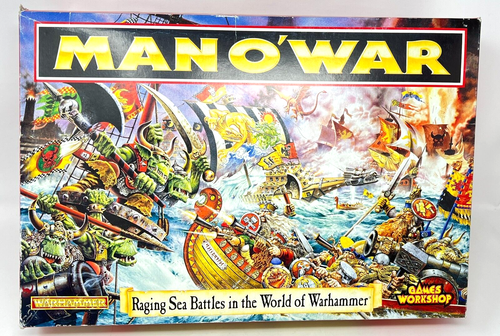
Back in 1993, Games Workshop finally asked the question all us young hobbyists had considered. "What if Warhammer...but wet?"
The answer was surprisingly inventive. Gone were the deep blocks of infantry whilst wizards exploded in administrative error. Man O'War shifted the viewpoint instead to the seas of the Old World and replaced the blood and mud of WHFB with cannon shot, boarding actions and the type of nautical experience that would would make the East India Trading Company blush. Also there were sea monsters. I am a sucker for sea monsters.
Whilst the bones of the game understood the need for nautical rulesets, Warhammer always should lean into the ridiculous, and thankfully, Man O'War decided that the 1990s level of weird was a perfect way to float these concepts. It worked too, with the High Elves setting sail in catamarans that looked like architecture having an identity crisis, while the dwarves decided they knew better than several hundred years of naval tradition and went to sea in more metal that 1999's Big Day Out. They also had submarines because when Dwarves find a problem, they just add yet more engineering.
The Empire had decidedly oddly normal-looking ships, but these were armed with enough gunpowder to accidently invent multiple new forms of catastrophe. Think of the Empire Fleet as being a stealth version of completely disregarding health and safety regulations. Speaking of which, The Orcs brought floating scrapyards that steered this side of disaster and concussion. The Dark Elves brought floating cities and weaponised marine biology.
As may be apparent, Man O'War was filled with character. The strength of the game came from the sometimes clunky, often elegant ruleset, but this was supported by more character than the average RPG core book. It dripped with atmosphere of cracking boards and the boom of cannons. It was the roar of the wind soaked into the typeset, and it captured imaginations of those like-minded players to took to the high seas with gusto. It knew exactly what it wanted to be.
It was often a game of chance, Wind direction was as important as positioning. Broadsides and boarding actions could make or break a battle plan. There was a cinematic quality to it compared to similar games of the time that required a a slide rule, a sextant and a degree in maritime history before making a single move. In this way, it may be the purest example of the Warhammer games design studio's atheistic. It's less military realism and more pure spectacle. It's why I struggle to engage with tournaments, and the tales told by the dice and the narratives that are built from these games envelop so much of the hobby. Warhammer works at it's best when there's a sense of dark and whimsy pushing at each other. And then a dragon gets added.
This is exactly where Man O'War sits. Line formations and logistics have their places, but whats are such concepts against a Sea-serpent with a castle strapped to it ship rammed a steam powered Dwarven battleship with a load of sea-fairing Goblins giggling from afar.
Plague Fleet came short after and added in the Chaos Powers, Skaven and Chaos Dwarves which pushed the aesthetic even further. I mean, the Big Hats were even on the ships as chimneys for the latter. Sea of Blood brought in more chaotic experiences with a further broadening of the scope. Towards the end of it's life, there was an impressive array of naval powers, each with its own character and flavour.
Unfortunately Man O'War also ended it's shelf life in that position that seems familar to many a release of this time. There was not enough of a fan base to keep it goinf. Granted, the Citadel Journal did a good job in extending it's life, but it's time came and went quickly.
Yes, Dreadfleet came after the turn of the millennium, but it wasn't the same. The style was different, though it was also drenched in the type of Blanche-born atmosphere most games can only dream of approaching, but it lacked the whimsy, the silly, the scale. Man O'War was not perfect, not by a long shot, damage control was often an affair akin to high level accounting, Fleets could feel a lot more eccentric than balanced, it is very much a game of counters, status markers and escalating chaos.
But there lies the charm. It's an ambitious, gloriously characterful and slightly mad moment in an era full of similar takes. Market Research takes a second chair to just seeing what was doable. It was a time of experiments and lightly-hinged designers seeing what they could create because they could......and then learning the importance of reaching an audience. There's something to be said of having this many scales, this many versions of the same world. The Micro-scale of Warhammer Quest through to Fantasy Battle through to Man O'War. The differing levels of view points all built the world we loved, in a way that even now, with more lines and product on the Warhammer shelves than any time in history, seems somewhat alien.
So, let's set sail for one more game eh?
Until next time, I remain
Adam