Sunday Musings - Chaosium Dreams
Some companies in this hobby feel like corporations in the modern sense of the word. Clean logos. Quarterly strategies. Product roadmaps that resemble subway maps designed by someone who believes joy is a design flaw. Others feel like brands, carefully cultivated vibes meant to be recognizable from across a convention hall. You see the booth, the banners, the fonts, and you immediately know the mood you’re supposed to have about it. Chaosium has never really been either. Chaosium feels more like a room you wandered into by mistake.
The lighting is a little dim. There are books everywhere, possibly more books than the shelving was ever rated for. Some of them appear to be about mythology. Some are about cults. Some are about things that might technically be mythology but feel suspiciously like arguments about anthropology that got out of hand sometime around 1976. Nobody seems particularly concerned that you’re there. In fact, nobody seems particularly concerned about anything except the contents of those shelves. You didn’t arrive because you were invited. You arrived because curiosity got the better of you, and now you’re standing there wondering how long this room has existed and whether you’re allowed to leave. That feeling of Chaosium as a place rather than a product line isn’t accidental. From the beginning the company revolved around the obsessions of Greg Stafford.
Stafford approached mythology in a way that was slightly inconvenient for marketing departments. He didn’t treat myth as a genre, or a decorative layer you drape over a fantasy setting to make it feel ancient and mysterious. For Stafford, myth was infrastructure. It was the framework the rest of the world had to stand on, which meant it was messy, contradictory, and full of uncomfortable implications. The world he built, Glorantha, wasn’t designed to be easy to explain in an elevator pitch. It was designed to feel like real mythology feels. Different cultures don’t simply worship different gods; they inhabit entirely different explanations for how reality works. The Orlanthi see the world through storms and rebellion. The Lunar Empire understands reality through cycles, illumination, and the unnerving suggestion that contradictions might all be true at the same time. Their gods disagree. Their histories overlap in awkward ways. Their cosmologies occasionally contradict each other outright. If two cultures describe the same mythic event differently, the setting does not rush in to clarify which one is correct. It simply accepts that belief itself has power, and that reality may be large enough to contain multiple incompatible truths. When RuneQuest appeared in 1978, it carried all of that philosophical baggage straight onto the gaming table.
RuneQuest didn’t arrive with the gentle onboarding experience modern players might expect. It presented a world, a rules system, and a set of assumptions, and then politely waited for players to catch up.Instead of levels, characters advance through skills—swordplay, riding, tracking, bargaining, the sorts of abilities people actually develop through practice. Instead of a single pool of hit points, damage lands on specific parts of the body. A solid axe blow to the arm might disable it. A spear through the leg might end the adventure before it has really begun. Armor matters because it physically stops damage. A bronze cuirass is not an abstract bonus. It is a slab of metal between you and a very real spear. Combat therefore tends to feel quick, tense, and occasionally alarming. Magic is similarly grounded in the setting’s religious structure. Characters don’t simply “learn spells.” They join cults. They swear oaths to gods. In exchange they receive access to divine magic that reflects that deity’s nature. Devote yourself to Orlanth and you might wield the storm. Follow Chalana Arroy and you become a healer sworn to nonviolence, which can make adventuring parties slightly awkward but morally interesting.
RuneQuest doesn’t go out of its way to make players feel powerful. Instead it assumes they would prefer to inhabit a world that behaves like a world. Your character is capable, certainly. Possibly even impressive by local standards. But they are surrounded by other capable people, unpredictable politics, hostile wildlife, and gods with their own priorities. You are not the center of the universe. The universe was here first.
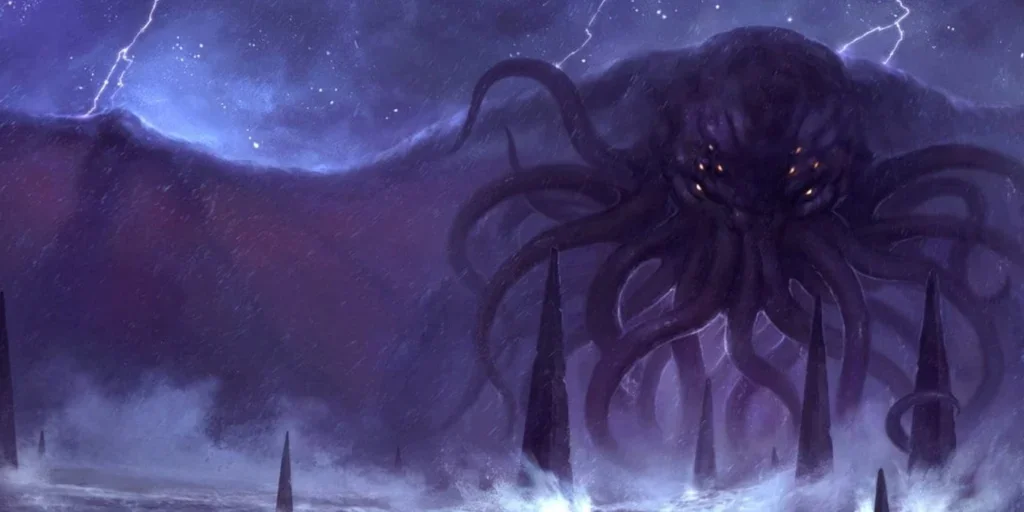
Then, in 1981, Chaosium released Call of Cthulhu and quietly proposed something that must have sounded faintly suspicious to players at the time. Most roleplaying games revolved around accumulation. You fought monsters, gathered treasure, improved your abilities, and eventually reached a point where the game world struggled to keep up with you. It was a comforting progression. Call of Cthulhu looked at that idea and suggested that perhaps knowledge itself might be the problem. Based on the cosmic horror fiction of H. P. Lovecraft, the game centers on investigators—academics, journalists, antiquarians, police detectives—who stumble across evidence that the universe is not only stranger than expected but actively hostile to human understanding. Ancient entities exist beyond time and morality. Cults worship them for reasons that make perfect sense if you stop valuing human survival as a priority. The game’s famous Sanity system is not merely there for dramatic effect. It is the mechanical backbone of the setting’s central idea: the human mind is not especially well equipped to process certain truths. Reading forbidden tomes, witnessing impossible creatures, or simply realizing how large and indifferent the cosmos truly is can chip away at a character’s mental stability. Combat exists, but it is rarely the solution players hope it will be. A revolver might stop a cultist, but it does very little against something that technically predates the concept of revolvers. Investigators therefore spend most of their time researching, interviewing witnesses, piecing together clues, and making increasingly nervous decisions about whether they should really open that cellar door.
Success in Call of Cthulhu tends to be modest. You might prevent a summoning ritual. You might destroy a dangerous artifact. You might even survive the experience with enough sanity intact to explain what happened to the authorities, who will almost certainly assume you are confused or drunk, after all, defeating cosmic horror outright is not really on the menu.
Then came Pendragon, which may be the most quietly radical game in their catalog largely because it refuses to hurry. Pendragon takes the legends of King Arthur and treats them not as a series of disconnected adventures but as a sweeping generational saga. A campaign might span decades of in-game time. Characters grow older. Political alliances shift. The kingdom rises, falters, and occasionally falls apart in ways that will be very familiar to anyone who has read Arthurian literature. Your knight does not simply ride from quest to quest forever. They marry. They manage estates. They raise children who may eventually inherit both their land and their problems. When a character dies—and in a setting full of jousting tournaments and Saxon invasions that eventually happens—the campaign continues with the next generation. Pendragon also takes character personality unusually seriously. Traits like Honor, Generosity, and Loyalty are represented mechanically, and they can influence a character’s behavior whether the player finds it convenient or not. A particularly honorable knight might feel compelled to accept a duel that common sense suggests declining. The result is a game where glory matters, but so do reputation, family legacy, and the slow passage of time. Players aren’t just building a powerful character. They’re building a lineage that will persist long after that character is gone.
Running quietly beneath many of these games is Basic Role-Playing, a rules framework so straightforward it almost disappears once play begins. The core mechanic is elegantly simple. Skills are expressed as percentages. Roll percentile dice and try to get under the number. If you succeed often enough, the skill improves. That’s the basic loop. The system doesn’t rely on elaborate mechanical fireworks or carefully engineered reward cycles. Instead it focuses on transparency and consistency. If your character has a 65% chance to climb a wall, you know exactly what that means. Over time this approach produces characters who feel shaped by experience. The swordsman becomes better at fighting because he fights. The scholar becomes better at research because she spends long nights buried in libraries. It’s a system that models growth through use rather than through sudden leaps in power.
Chaosium’s history, like most long-lived companies, has not been perfectly smooth. The 1990s and early 2000s were particularly awkward. The roleplaying industry was shifting. Distribution models changed. Projects expanded in scope until they occasionally wandered off for years at a time. There were moments when Chaosium felt less like a streamlined publisher and more like a slightly chaotic archive of fascinating manuscripts waiting for someone to organize them properly. But even during those messy periods the company never seemed especially interested in becoming something else. It didn’t aggressively chase trends. It didn’t attempt to sand down the peculiarities that made its games distinctive. Chaosium simply continued being Chaosium, which is either admirable stubbornness or a complete inability to behave like a normal business, depending on how charitable you’re feeling that day. When the company stabilized again in the 2010s, the revival didn’t look like a dramatic reinvention rather a careful restoration. Production values improved and the core game lines were consolidated and polished.
Call of Cthulhu received a thoughtful modern edition that clarified the rules without diluting the tone. RuneQuest returned firmly to its mythic roots in Glorantha. Pendragon continued its slow march through Arthurian history with renewed attention to presentation and structure. There was no sudden pivot toward whatever trend happened to be fashionable that year. No attempt to reinvent the company’s identity. Just the same room as before, perhaps with sturdier shelving and better lighting. What Chaosium represents, more than anything else, is a different idea of what roleplaying games can be.
They can be slower. They can be stranger. They can assume that players are willing to deal with consequences, uncertainty, and the occasional shattered knee that requires six weeks of recovery and a serious conversation about life choices. In a hobby that often rewards immediacy and spectacle, Chaosium has spent decades exploring quieter questions. What do people believe? What happens when those beliefs collide with reality? How much can a person endure once they start asking questions that really should have been left alone? The company still feels less like a brand and more like that dimly lit room. The shelves are still bending under the weight of ideas. The books are still being added faster than anyone can properly catalogue them.
And if you wander in out of curiosity, no one will stop you.
They might not even notice. Which, honestly, is probably how they prefer it.