
Bloody Books -Stuff Of Legends Vol 1
Every hobby has its legends. Some are remembered because they sculpted the miniatures that defined our collections. Others because they wrote the rules that consumed entire weekends and occasionally lifelong friendships. A few became household names simply by painting tiny goblins to an impossible standard. Then there are the custodians, the archivists. The people who quietly preserve the history that everyone else is too busy making. Their names rarely appear on the front of boxes or in glossy advertisements, but without them entire chapters of our hobby would simply disappear. Richard "Orclord" Hale was one such person.
Richard's passing earlier this month has left the Oldhammer community immeasurably poorer. For well over thirty years, The Stuff of Legends website became the place collectors inevitably found themselves loosing hour after hour. Whether you had unearthed a mysterious Citadel barbarian from the depths of a bargain bin, inherited a box of Grenadier figures from an uncle who hadn't rolled a dice since Thatcher was stealing milk, or simply wished to lose an entire afternoon browsing lovingly catalogued galleries of lead nostalgia, Richard had already done the work. He had photographed it, researched it, organised it and preserved it. He never simply collected old miniatures. He collected their histories. In a hobby that often obsesses over the next release, Richard spent decades ensuring we never forgot the last one.
That makes this book feel strangely different now.
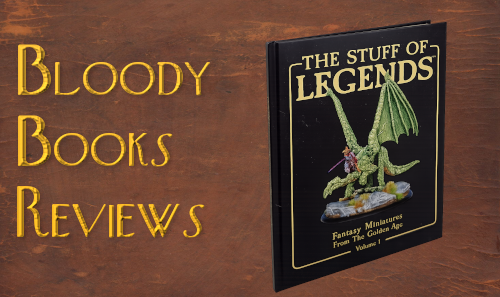
When The Stuff of Legends: Fantasy Miniatures from the Golden Age – Volume I was first announced, it looked to become one of the finest coffee table books ever produced for miniature collectors. Beautifully photographed, meticulously researched and clearly assembled by somebody whose enthusiasm bordered on the wonderfully obsessive, it was an obvious recommendation to go alongside Talking Miniatures and Kev Adam's Goblinmaster. Following Richard's death, however, it has quietly transformed into something else entirely. This is no longer simply a lavish celebration of classic fantasy miniatures. It has become part of Richard Hale's own legacy.
The greatest compliment I can pay this book is that it understands exactly what made the this era of miniature production so magical. Modern fantasy miniatures are technical marvels. Digital sculpting allows artists to produce impossibly intricate figures with enough surface detail to keep a painter occupied until retirement. They are objectively better miniatures in almost every measurable sense. Yet somewhere between polygon counts and injection-moulded perfection, something became a little too sensible. The miniatures filling these pages come from an era when fantasy was gloriously untidy. Goblins had enormous noses. Trolls resembled half-melted bridge trolls from uncomfortable fairy tales rather than carefully branded intellectual property. Dwarfs looked like men who genuinely spent twelve hours a day underground instead of maintaining strict gym memberships. Dragons were weird. Wizards were even weirder. Anatomy often appeared to be little more than a polite suggestion. Nobody seemed remotely concerned that a sword was longer than the warrior carrying it, because if it looked dramatic then that was entirely justification enough.
The photography deserves enormous praise because it refuses to sanitise any of this eccentricity. Every sculpt is presented with affection rather than embarrassment. Casting imperfections remain visible though painted to an high level showroom standard. These figures are not treated as obsolete products but as historical artefacts. Looking through the book often feels less like browsing a catalogue and more like wandering through a museum dedicated to the strange little lead people who accidentally built an industry.
What continually struck me was just how astonishingly diverse the hobby once was. It is remarkably easy to view fantasy miniatures through the lens of Games Workshop because, for many people, Games Workshop effectively became the hobby. Richard gently reminds us that the landscape was vastly richer than that. Citadel sits comfortably alongside Asgard, Ral Partha, Marauder, and other companies whose names now survive only in collectors' conversations and the occasional miracle discovered on eBay at 3am. Every manufacturer brought its own peculiar interpretation of fantasy. Every sculptor possessed an unmistakable signature. There was experimentation everywhere, not because focus groups demanded it, but because somebody simply thought it might be interesting. That freedom radiates from every page.
There is also something wonderfully reassuring about Richard's approach to history. This is not an academic textbook weighed down by endless release dates and production numbers, nor is it a superficial picture book assembled purely to look attractive on a coffee table. It sits comfortably between the two. The commentary provides enough context to enrich every photograph without ever overwhelming it, allowing the miniatures themselves to remain the stars of the show. Contributions from respected figures within the hobby feel earned rather than obligatory, while Rick Priestley's foreword quietly reminds us that these little metal warriors represent far more than commercial products. They represent a shared cultural memory stretching back nearly half a century. Perhaps the book's greatest achievement is that it rekindles curiosity. I found myself repeatedly looking up some of these ancient minis (and in one case, checking ebay for prices of Chaos Sorcerers). I’ve spoken at length about the problem I have with “disposable media”, and this tome is the exact opposite of that issue. The Stuff of Legends actively encourages exploration. It whispers dangerous ideas into your ear. "Perhaps you do need a collection of obscure Jes Goodwin barbarians." "Surely one Ral Partha Balrog won't hurt."
There is an undeniable melancholy that now hangs over every chapter. Not because the book dwells on loss, but because readers cannot help recognising that its author is no longer here to continue the extraordinary work he began all those years ago. Yet there is comfort in that as well. History survives because someone chooses to preserve it. Richard Hale chose to preserve ours. Generations of collectors, painters and gamers have benefited from thousands upon thousands of hours of patient research undertaken not for profit or recognition, but simply because the history of fantasy miniatures deserved to be remembered. That quiet generosity echoes from every single page. It is simultaneously an art book, a historical archive, a collector's guide and a heartfelt love letter to the eccentric, chaotic and endlessly imaginative decades that shaped fantasy miniature gaming forever. More than that, it stands as a fitting memorial to the man who devoted so much of his life ensuring that none of it would ever be forgotten.
Richard Hale preserved our hobby's past with extraordinary care and remarkable humility. The least we can do is preserve his work with the same affection. He gave the hobby a priceless gift. This magnificent volume ensures that gift will endure for generations.