FIVE WAYS INTO 40K
So you've decided to get a friend, family member, loved one or hated enemy into Warhammer 40,000. Excellent. This is a hobby where grown adults willingly spend hundreds of pounds on tiny plastic soldiers, complain that they don't have enough free time, then immediately buy another army because "these ones wear slightly different helmets." Naturally, the next sensible step is to tackle the literature. At the time of writing there are somewhere in the region of four hundred Black Library novels, enough lore to fill several cathedral libraries, and approximately six contradictory explanations for every historical event.* It's a wonderful mess, but it can also feel like being handed the Encyclopaedia Britannica and being told, "Just start at A."
Fortunately, you don't need to begin at the beginning. In fact, you probably shouldn't. The best Warhammer novels don't expect you to know what a Gellar Field is, why everyone fears the number eight, or why there are so many skulls attached to perfectly functional machinery. They simply introduce you to the galaxy one beautifully miserable story at a time.
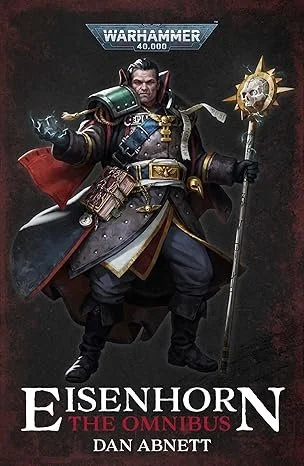
If there is one place to begin, it is The Eisenhorn Trilogy by Dan Abnett. There is a reason this recommendation appears with the inevitability of an Imperial tax collector. Rather than following a genetically engineered demigod capable of punching tanks into retirement, Eisenhorn introduces us to Gregor Eisenhorn, an Inquisitor whose job is essentially equal parts detective, secret policeman, theologian and professional worrier. Through his investigations you learn about Chaos, the Warp, Imperial society, aliens, daemons and every variety of unpleasantness the galaxy can produce, all at a pace that never feels like you're being force-fed thirty years of background material. It also helps that Abnett writes with enough confidence to make even endless bureaucratic investigations feel like a thriller. If Warhammer 40,000 has a gateway drug, this is probably it.
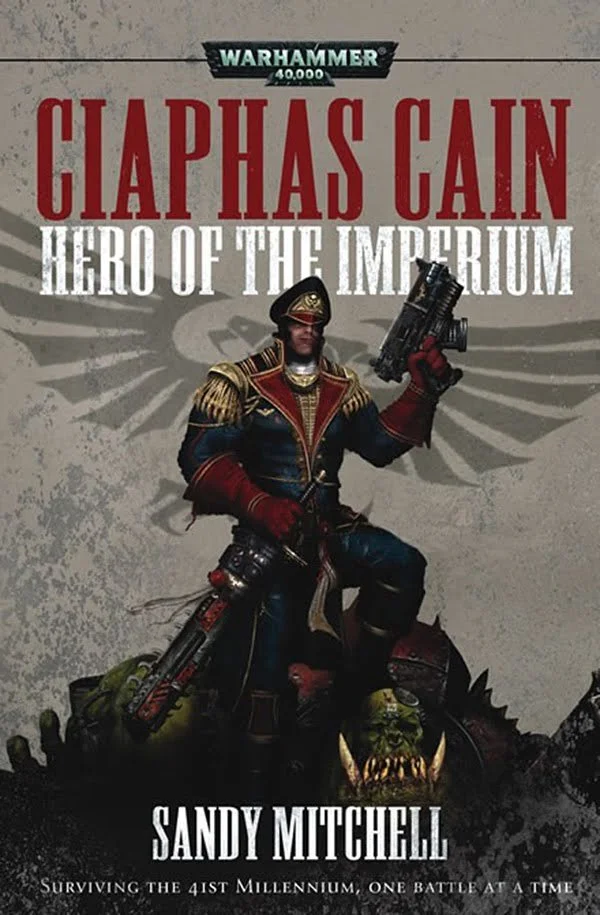
Once you've realised that everyone in the Imperium is either traumatised, fanatical or both, it's time for something considerably lighter. Ciaphas Cain by Sandy Mitchell is often described as the Blackadder of the 41st Millennium, which is wonderfully inaccurate but close enough that nobody throws tomatoes when you say it aloud. Cain has somehow acquired the reputation of being the greatest hero in the Imperium despite spending most of his career desperately trying to avoid becoming a corpse. Every brave act is usually the result of blind panic, catastrophic luck or attempting to run away in exactly the wrong direction. Alongside him is Gunner Jurgen, whose body odour appears to be recognised as an official weapon of the Imperium. Together they prove that even in a universe where planets are consumed by alien horrors, there is always room for dry wit and spectacular misunderstandings.
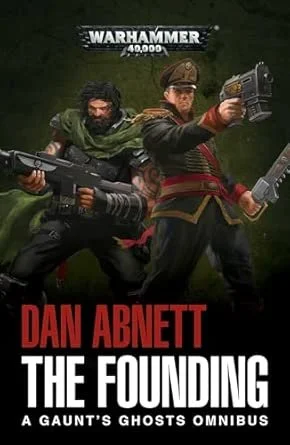
Having laughed in the face of inevitable doom, it's time to discover what life is actually like for the ordinary men and women expected to hold back the darkness with little more than a lasgun and unhealthy optimism. Gaunt's Ghosts: The Founding remains one of the finest military science-fiction series ever written. Colonel-Commissar Ibram Gaunt commands the Tanith First-and-Only, a regiment whose home world was destroyed before most of them even had the chance to leave it. They aren't superhuman. They don't wear armour the size of a family hatchback. They simply keep marching because there is nobody else to do it. Dan Abnett somehow manages to make logistics, trench warfare and impossible last stands into genuinely emotional storytelling, and before long you'll discover you've developed favourite guardsmen purely so the next novel can emotionally devastate you. It absolutely will.
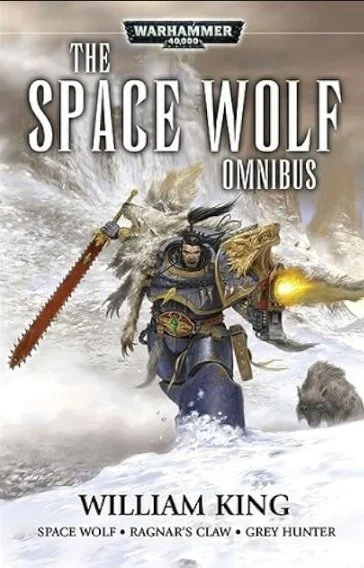
Of course, sooner or later everyone wants to read about Space Marines, those towering post-human warriors who solve diplomatic disagreements by introducing people to chainswords. For that, the Space Wolf Omnibus remains one of the best introductions. William King's tale follows Ragnar Blackmane from half-feral tribesman on the frozen death world of Fenris to one of the Imperium's greatest champions. Along the way you experience the recruitment process, the culture of the Space Wolves and enough Viking-inspired heroics to make a Norse skald politely ask everyone to calm down. The novels are undeniably products of the late 1990s, carrying all the wonderfully over-the-top enthusiasm of early Black Library fiction, but sometimes that's exactly what you want. Not every meal needs to be sophisticated when someone is offering you a perfectly cooked steak the size of a shield.
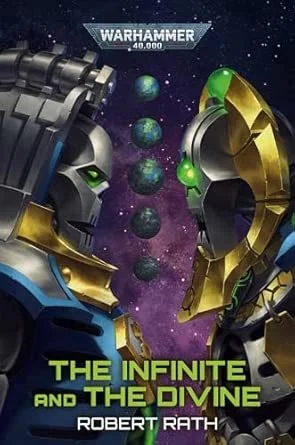
One modern addition that has rapidly earned its place among the classics is The Infinite and the Divine by Robert Rath. On paper, it's the story of two immortal Necron overlords locked in a bitter feud that spans over ten thousand years. In practice, it's what happens when two impossibly ancient, hyper-intelligent robot kings spend millennia behaving like particularly vindictive neighbours arguing over whose hedge is six inches too tall. Trazyn the Infinite, the galaxy's most accomplished kleptomaniac and curator of "borrowed" history, squares off against Orikan the Diviner, an astromancer so spectacularly arrogant that reality itself occasionally has to remind him he's not actually in charge. Their rivalry leaves entire civilisations in ruins, planets rise and fall, and countless innocent bystanders become collateral damage in what is, at heart, the longest-running petty argument in science fiction. Beneath the comedy lies one of the smartest explorations of the Necrons ever written, offering a refreshing perspective outside the Imperium while somehow making immortal murder robots surprisingly sympathetic. It's hilarious, tragic, surprisingly philosophical and proof that even in Warhammer 40,000, where every problem is supposedly solved with overwhelming violence, sometimes the greatest weapon is simply refusing to let something go for ten millennia.
These five recommendations won't teach you absolutely everything about Warhammer 40,000. Nothing short of several decades, a suspicious number of hardbacks and an unhealthy relationship with online wikis will achieve that. What they will do is give you the broadest possible tour of the setting without requiring a glossary the size of a paving slab. You'll meet inquisitors, soldiers, heroes, cowards, monsters, bureaucrats and Space Marines, all while gradually discovering why humanity's official long-term strategy appears to be "make the problem someone else's problem until they die."
Which, in fairness, has been remarkably effective for the last ten thousand years.
The other six explanations are also possibly canon. Ask Orikan**
**See Infinite and The Divine