BLOODY BOOKS REVIEW — IMPERIAL CREED by David Annandale
There's a problem with how we, the players, see a named character in a army book or on the table and how that character is developed and explored in fiction. It's often easier to create a character and transport it onto the battlefield than to take one that exists and flesh it out. Sometimes you get Malus Darkblade and that's never a good thing*.
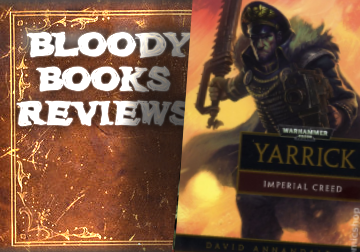
Imperial Creed side steps some of those issues by exploring the early years of Commisar Sebestian Yarrick as he is exposed to the political machinations on the world of Mistral. Here, he has to navigate the Imperial nobles pushing back against the Ecclesiarchal power bloc of Cardinal Wangenheim. AN dyes, the book gets a free point in in it's favour for that name. Alongside Yarrick is a company of 77th Mortisian Infantry, a fellow Commissar named Seroff and the Lord Commissar Rasp (the names are ace, there's no bones to be made there). I also would like to say that I adore Rasp and wish there was books about how and his way of teaching young un's the way of the world. Well. Worlds. Rounding out the cast is one Inquistor Krauss and the Sisters of Battle led by Sister Superior Setheno, who are unfortunately underserved by the novel somewhat. I would love to have seen more of them
The first third or so of the book is honestly great stuff. It's the 40k you rarely see (or used to see), the sort of moments that the Cain books do well. The society of the rich and powerful is alive and well with lots of balls**. Annadale does a wonderful job in mundane evil, in the scheming of the selfish and just how dangerous such moments can be in the 40k universe.
A shift takes place however, and this wonderful exploration turns into a on-the-rails experience that shoot past at a rate of knots. Having confusion in the fog or war is not a bad narrative device, but it's had to get a foothold on where you are or the scale of the moment. Without any moments to take stock, the attention does wander somewhat., punctuated by genuinely great moments that rise above the cacophony.
All of Yarrick's chapters are told in first person, and everyone else gets third person narratives. Once again, this isn't a bad trick in itself, but it causes issues with tension and forward motion. However, those chapters where we are with Yarrick are easily the highlights. He's Yarrick, less scars and experience, but very much Yarrick, and through the realtionship and dealings with Inquistor Krauss we get to see the man who will face down Ghazgull Thraka. Unfortunately, that gets a mention and the inclusion does not land well.
It's a real issue throughout the book. It's so caught up in being a prequal to the Yarrick we know, it rushes through the tale it's here to tell. The immanent danger is constantly undercut by what we know of the future to the point the tensions flushes away entirely. Tropes rises up and familiarity beats a well worn path throughout the final chapters and what started strong simply comes to an end. It's a shame, as it is worth reading, but hard to recommend.
*see almost every issue of WHAM!
**Gala. Not what you were thinking